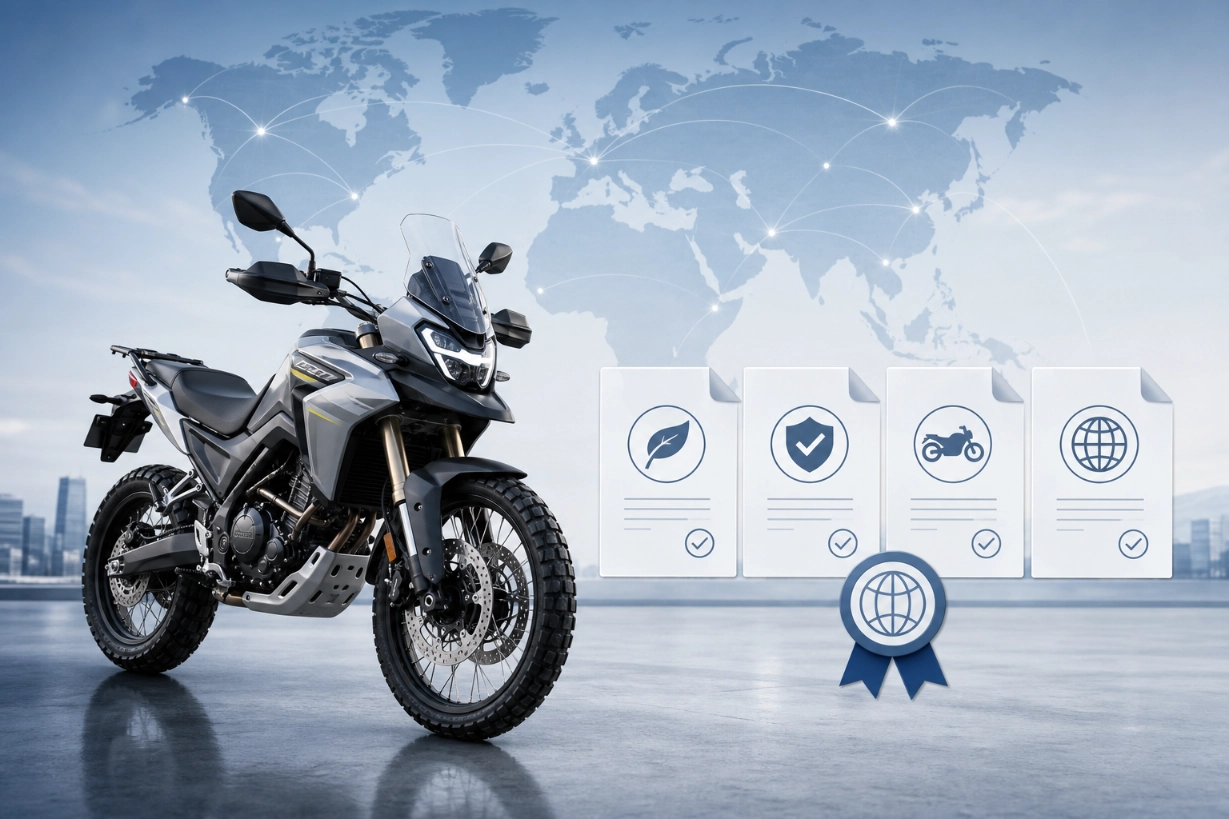
Motorcycle homologation is the official approval process that confirms a motorcycle meets the safety, emissions, noise, lighting, identification, and road-use regulations required in a target market. For motorcycle importers, distributors, brand owners, and CKD/SKD assemblers, homologation is one of the most important steps before placing an international order.
A motorcycle may have the right design, price, engine size, and performance, but if it does not meet local compliance requirements, it may face customs delays, registration failure, sales restrictions, recalls, or unsellable inventory.
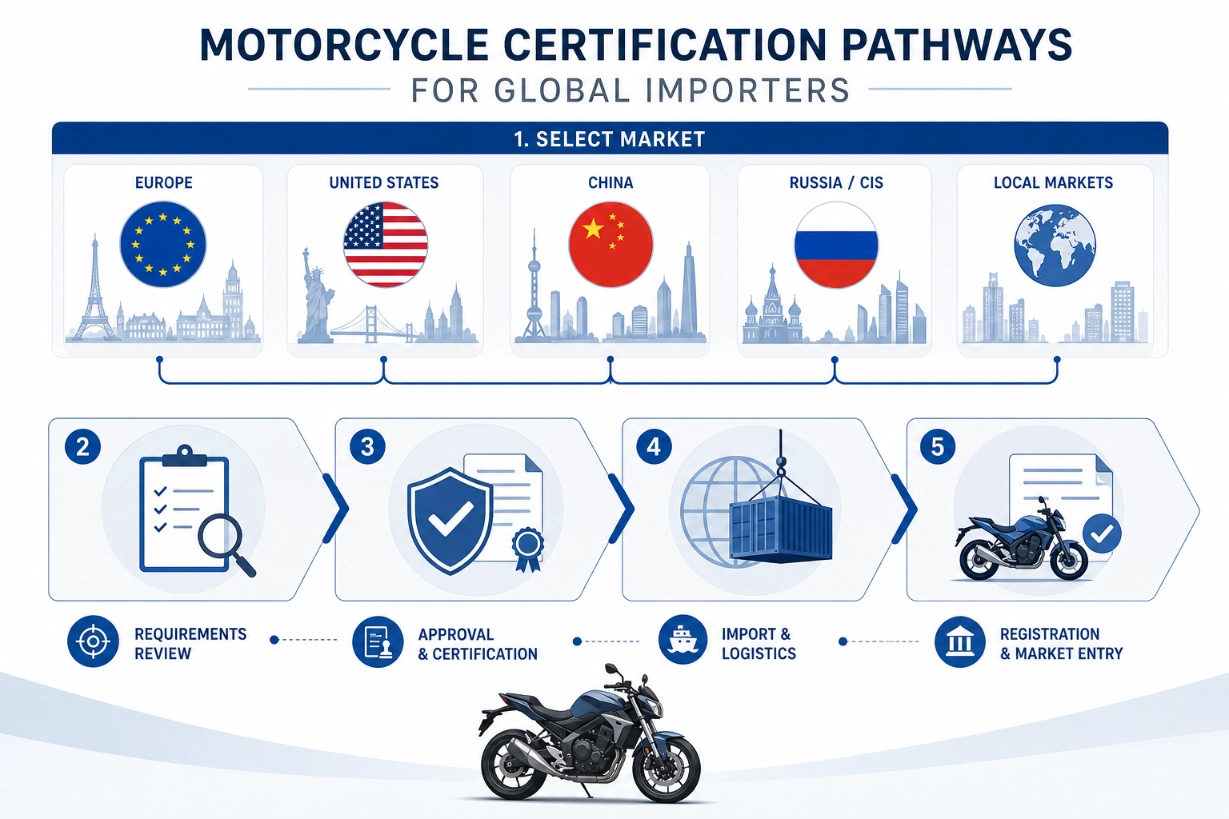
This guide explains the major motorcycle compliance pathways, including EEC/E-type approval, EPA-related requirements, CCC certification, OTTS, and local market approvals. It also provides a practical checklist for B2B buyers sourcing motorcycles from China.
KAMAX Ind. Co., Ltd. is a Chongqing-based motorcycle OEM/ODM manufacturer serving global importers, distributors, dealers, brand partners, and CKD/SKD assemblers. Founded in 2001, KAMAX supports international motorcycle programs with market-specific configuration, export documentation, quality control, and homologation coordination depending on destination and model.
What Is Motorcycle Homologation?
Motorcycle homologation is the process of verifying that a motorcycle model complies with the technical regulations of a specific country or region.
These regulations may cover:
- Exhaust emissions
- Evaporative emissions
- Noise level
- Braking system
- Lighting and indicators
- Mirrors and reflectors
- Tires and wheels
- Speedometer and instrument cluster
- Vehicle identification number, or VIN
- Labels and warning marks
- Engine and ECU configuration
- Safety-related components
- User manual and technical documentation
In simple terms, homologation answers one key question:
Can this motorcycle be legally imported, registered, sold, and used in the target market?
For importers, this question should be answered before mass production begins, not after motorcycles arrive at the destination port.
Why Motorcycle Homologation Matters for Importers
Homologation is not just a technical issue. It affects the entire import business.
For motorcycle importers and distributors, proper compliance planning helps reduce risks such as:
- Customs clearance delays
- Registration failure
- Government penalties
- Product recalls
- Unsellable inventory
- Dealer complaints
- Warranty disputes
- Additional modification cost
- Brand reputation damage
For CKD and SKD motorcycle assemblers, homologation can be even more complex. Local assembly, local content rules, inspection procedures, and country-specific documentation may create additional requirements.
That is why importers should confirm the target country, intended use, model configuration, certificate scope, documentation, labeling, and technical requirements before confirming the purchase order.
Common Motorcycle Certification Pathways by Market
Different markets use different approval systems. One certificate does not automatically cover every country.
| Certification / Approval | Common Market | Main Focus | What Importers Should Confirm |
|---|---|---|---|
| EEC / E-type Approval | European Union and related markets | Emissions, lighting, braking, noise, safety | Model applicability, Euro emission level, certificate validity |
| EPA | United States | Exhaust and evaporative emissions | Engine family, model year, emissions configuration |
| DOT / NHTSA | United States | Road safety and vehicle standards | Road-use status, labels, safety compliance |
| CCC | China | Product safety and conformity | Applicable product category and certified configuration |
| OTTS | Russia and selected CIS markets | Vehicle type approval | Approval scope, documents, VIN, local requirements |
| Local Type Approval | Southeast Asia, Latin America, Africa, Middle East | Country-specific standards | Import documents, emissions, lighting, registration rules |
Importers should always verify the exact requirement in the destination country. Even if two countries recognize similar standards, registration procedures, document formats, labeling rules, or distributor responsibilities may still differ.
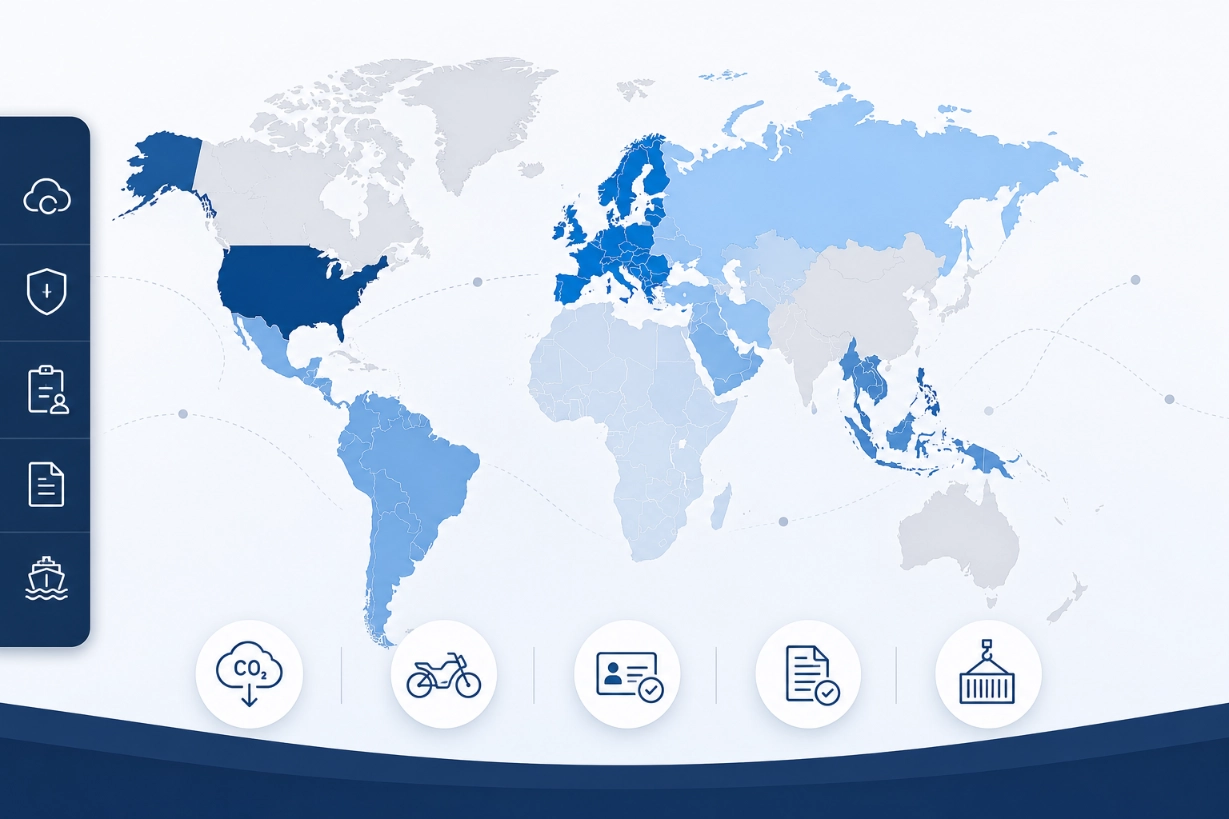
Motorcycle Compliance Requirements by Region
The table below gives a practical overview for B2B motorcycle buyers.
| Target Market | Common Compliance Concern | Buyer Priority |
|---|---|---|
| European Union | EEC/E-type approval, Euro emissions, lighting, braking, noise | Confirm exact model approval and road registration documents |
| United States | EPA emissions, DOT/NHTSA for road-use motorcycles | Confirm on-road or off-road classification |
| Russia / CIS | OTTS and local technical regulations | Confirm approval scope and Russian-language documentation |
| Southeast Asia | Local type approval, emissions, lighting, import permit | Confirm country-specific configuration |
| Latin America | Import approval, emissions, VIN, customs documentation | Confirm documents and spare parts support |
| Africa | Varies by country, often focused on durability and import documents | Confirm local importer responsibility and after-sales plan |
| Middle East | Market-specific conformity, emissions, heat/dust suitability | Confirm environmental adaptation and documents |
This is why importers should avoid choosing motorcycles only by price or appearance. Compliance, after-sales, and documentation are equally important for long-term success.
EEC / E-type Approval for Europe and Related Markets
EEC or E-type approval is commonly required for motorcycles entering the European Union and some related regulated markets. It confirms that a vehicle or component meets required standards for safety, emissions, lighting, braking, mirrors, tires, reflectors, and noise.
For European motorcycle imports, buyers should confirm:
- Does the exact model have applicable EEC or E-type approval?
- Which emission level does the motorcycle meet?
- Is the engine configuration the same as the approved version?
- Are the ECU, exhaust, fuel system, and catalytic converter consistent with the approval?
- Are lights, mirrors, tires, brakes, reflectors, and instruments approved?
- Are required documents available for customs and registration?
A common mistake is assuming that a similar model is automatically covered. In reality, changes to the engine, ECU, exhaust, tire size, braking system, lighting system, or vehicle category may affect approval validity.
For importers, the safest approach is to confirm the model code, technical specification, certificate scope, and destination country before production.
EPA Requirements for the United States
For the United States, EPA requirements mainly focus on emissions compliance. Depending on the motorcycle category and intended use, importers may also need to consider DOT or NHTSA-related requirements for road-use motorcycles.
Before importing motorcycles into the U.S., buyers should clarify:
- Is the motorcycle for on-road or off-road use?
- Does the engine family meet applicable EPA requirements?
- Is the model year correctly documented?
- Are emissions labels available?
- Are required import documents prepared?
- Does the product need DOT or NHTSA-related compliance?
- Is the vehicle suitable for registration in the intended state or market?
This is especially important for dirt bikes, MX/Enduro models, and competition motorcycles. A motorcycle designed for off-road or racing use may not automatically be legal for public road registration.
Importers should clearly define the product use case before ordering: road use, off-road recreation, competition, farm use, fleet delivery, or local assembly.
CCC Certification for China and China-Origin Programs
CCC, or China Compulsory Certification, is an important conformity system in China. It may apply to motorcycles sold in the Chinese domestic market or specific China-origin programs.
For international buyers, CCC may not always be the final approval required by their destination country. However, CCC-related experience can still indicate that a manufacturer understands regulated production, documentation control, conformity management, and quality consistency.
Importers should ask:
- Is CCC applicable to this model or program?
- Does the model configuration match the certified version?
- Are factory inspection and quality system records available if needed?
- Can the supplier provide technical documents for compliance review?
- Will OEM or ODM changes affect conformity?
For customized motorcycle projects, changes in styling, engine displacement, ECU, exhaust system, lighting, or braking components should be reviewed carefully because they may affect certification or require additional validation.
OTTS Certification for Russia and CIS Markets
OTTS is commonly associated with vehicle type approval for Russia and selected CIS markets. For motorcycle distributors in these regions, OTTS-related compliance may be necessary before legal import, registration, and sales.
Importers should confirm:
- Whether the selected model is covered
- Whether the approval applies to the required displacement
- Whether the approval covers the exact configuration
- Whether documents match the importer, brand, and destination market
- Whether Russian-language documentation is required
- Whether VIN, labels, and customs documents meet local rules
- Whether recent regulatory updates affect the product
Russia and CIS markets can have specific documentation, labeling, and customs requirements. Importers should work with both their local compliance partner and motorcycle supplier before shipment.
Homologation vs Certification: What Is the Difference?
In daily business communication, importers often use “homologation” and “certification” together. However, they are not always exactly the same.
Homologation usually refers to the official approval process that allows a vehicle type to be sold or registered in a specific market.
Certification may refer to a certificate, test report, component approval, quality system certificate, or conformity document.
For example:
- A motorcycle may need type approval for road registration.
- A lighting component may need E-mark approval.
- A manufacturer may hold ISO 9001 certification.
- An engine family may need emissions-related approval.
- A shipment may need a certificate of origin.
Importers should not only ask, “Do you have certification?”
They should ask, “Does this exact model and configuration meet the required approval for my country?”
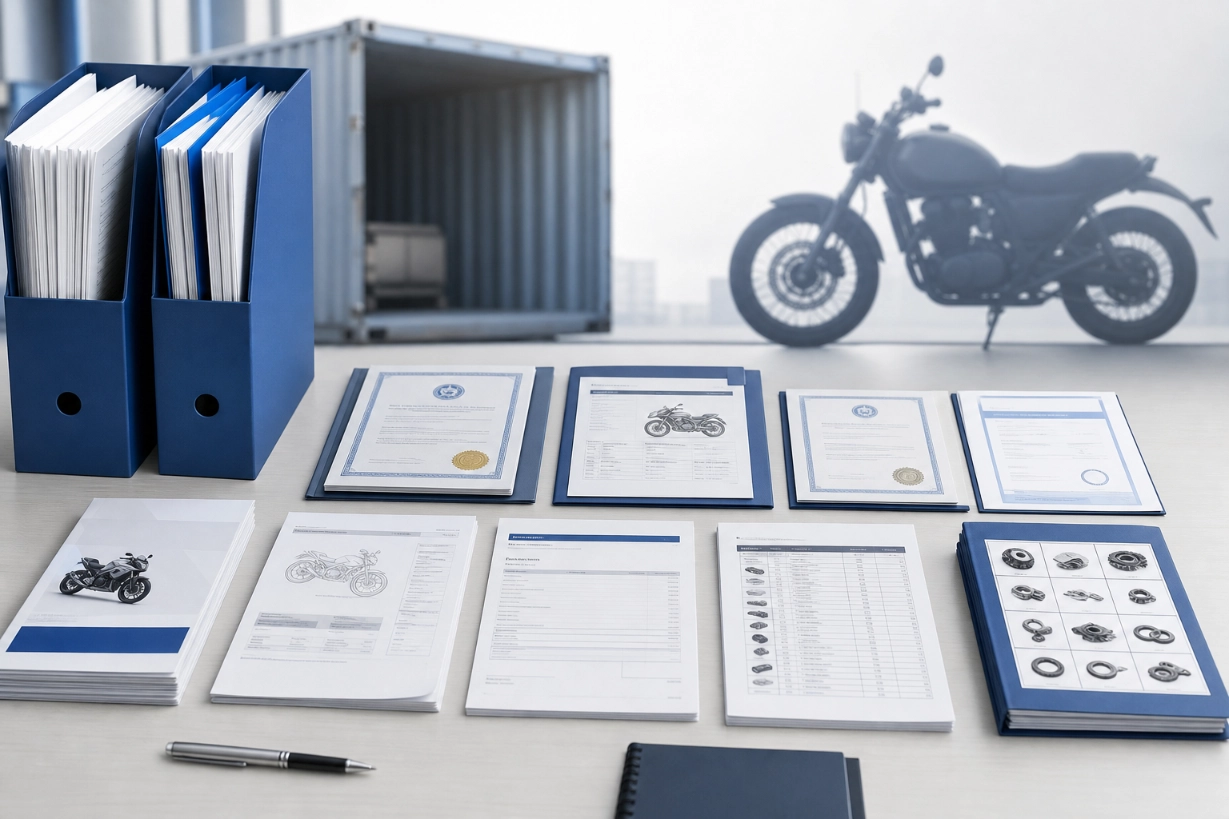
Documents Importers Should Request from a Motorcycle Supplier
Before confirming a motorcycle order, importers should request a compliance document review.
Common documents include:
- Product specification sheet
- Engine specification
- Emissions-related information
- Certificate copies, if applicable
- Test reports, if applicable
- VIN structure information
- Bill of materials, or BOM
- User manual
- Service manual
- Spare parts catalog or EPC
- Labeling and marking samples
- Packing list
- Commercial invoice
- Certificate of origin
- Warranty policy
- Compliance declaration, where applicable
For CKD and SKD motorcycle programs, buyers may also need:
- Assembly instructions
- Torque specifications
- Local assembly process guide
- Quality inspection procedures
- Packaging layout
- Container loading plan
- Technician training materials
- Spare parts recommendation list
The more complete the documentation, the easier it is for importers to manage customs, registration, dealer training, after-sales service, and warranty claims.
How Compliance Affects Motorcycle Configuration
Homologation is not only paperwork. It can affect the motorcycle itself.
Depending on the target market, compliance requirements may influence:
- Engine calibration
- ECU mapping
- Fuel injection system
- Exhaust system
- Catalytic converter
- Evaporative emission system
- Brake system
- Lighting and indicators
- Reflectors
- Mirrors
- Tires
- Speedometer
- Noise control components
- VIN plate
- Warning labels
- User manual
- Packaging and shipping documents
For example, a motorcycle for one market may require a different lighting setup, emissions system, or label format from another market. If the importer changes the specification after approval, the existing certificate may no longer apply.
That is why technical configuration and compliance documents should be managed together.
How Homologation Affects Lead Time and Cost
Compliance can also affect project cost and delivery schedule.
If a motorcycle model already has a suitable approval pathway for the target market, the project may move faster. If the model requires new testing, new documentation, component changes, or re-validation, the lead time may be longer.
Factors that may affect lead time include:
- Target country regulations
- Model category
- Engine displacement
- Emissions level
- Availability of existing certificates
- Need for component changes
- Testing schedule
- Document translation
- Local importer registration process
- CKD/SKD assembly requirements
Importers should discuss homologation at the quotation stage, not after production begins.
Common Motorcycle Compliance Mistakes Importers Should Avoid
Many motorcycle import problems come from avoidable mistakes.
Common mistakes include:
- Assuming one certificate works for every country
- Choosing a model before checking local regulations
- Changing the engine, ECU, exhaust, brakes, or lights after approval
- Importing off-road motorcycles for road use without checking local rules
- Ignoring noise and lighting requirements
- Not confirming VIN and label formats
- Relying only on verbal supplier confirmation
- Checking compliance after production has started
- Not preparing user manuals or service documents
- Forgetting spare parts and warranty requirements
- Not confirming whether CKD/SKD units need separate local approval
- Not involving a local compliance consultant when regulations are complex
The safest strategy is simple: confirm the destination market first, then select the right motorcycle configuration.
Supplier Compliance Checklist for Motorcycle Importers
Before placing an order, importers should ask the supplier these questions:
- Have you exported motorcycles to our country or region before?
- What certification pathway applies to this model?
- Does the exact model configuration match the approval?
- Can you provide certificate copies or test reports if applicable?
- Are the engine, ECU, exhaust, lights, brakes, tires, and labels compliant?
- Can you support VIN and key component traceability?
- Can you provide user manuals, service manuals, and EPC?
- Can you support CKD/SKD documentation if we assemble locally?
- How will compliance affect price and lead time?
- What documents are included before shipment?
- What warranty and spare parts support do you provide?
- Who is responsible for local registration or final type approval?
This checklist helps importers avoid the common problem of buying motorcycles first and discovering compliance issues later.
How KAMAX Supports Market-Specific Motorcycle Compliance
KAMAX Ind. Co., Ltd. is a Chongqing-based motorcycle OEM/ODM manufacturer founded in 2001. KAMAX supplies motorcycles to global B2B buyers, including importers, distributors, dealers, fleet operators, brand owners, and CKD/SKD assemblers.
KAMAX’s motorcycle range includes:
- Cub motorcycles
- Commuter motorcycles
- Dual sport motorcycles
- MX/Enduro motorcycles
- Street motorcycles
- Electric motorcycle programs
- Customized OEM/ODM models
For international buyers, KAMAX supports market-specific motorcycle programs depending on destination country and selected model. This may include CCC, EPA-related requirements, EEC/E-type pathways, OTTS-related programs, and local compliance coordination where applicable.
KAMAX also provides:
- OEM and ODM customization
- Market-specific configuration adaptation
- CKD/SKD packaging support
- VIN and key component traceability
- Product documentation
- Service manuals and EPC support
- Spare parts planning
- Export coordination
- After-sales support for distributors
KAMAX operates as a motorcycle manufacturer-exporter with global market experience, serving customers across Southeast Asia, Latin America, Europe, Russia/CIS, Africa, and other regions.
Because each destination market has different rules, buyers should confirm certificate applicability, model configuration, documentation scope, and lead time with KAMAX before placing an order.
Buyer Checklist Before Confirming a Motorcycle Order
Before signing a purchase contract, importers should confirm:
- Destination country
- Intended use: on-road, off-road, fleet, delivery, competition, or local assembly
- Required certification or approval pathway
- Exact model code and configuration
- Engine and ECU specification
- Exhaust and emissions system
- Brake, light, tire, mirror, and reflector requirements
- VIN and label format
- User manual and service manual
- Certificate or test report availability
- CKD, SKD, or CBU shipping method
- Spare parts plan
- Warranty policy
- Local registration responsibility
- Lead time impact
- Final document package before shipment
This checklist should be reviewed before production, especially for OEM/ODM projects.
Conclusion
Motorcycle homologation is one of the most important steps in international motorcycle sourcing. It determines whether a motorcycle can be legally imported, registered, sold, and supported in the target market.
For importers, distributors, brand owners, and CKD/SKD assemblers, the best approach is to confirm compliance before confirming the final model specification. Buyers should review the destination country, intended use, approval pathway, certificate scope, technical configuration, documents, labeling, spare parts, and after-sales support.
KAMAX Ind. Co., Ltd., a Chongqing-based motorcycle OEM/ODM manufacturer founded in 2001, supports global B2B buyers with market-specific motorcycle solutions, export documentation, CKD/SKD programs, product configuration, spare parts planning, and long-term distributor support.
Contact KAMAX to confirm the right motorcycle configuration and compliance pathway for your market.