OEM vs ODM Motorcycles: Which Model Fits Your Market? For importers, distributors, and dealer groups, choosing between OEM and ODM motorcycles is not just a product decision. It is a business model decision. The choice affects launch speed, branding flexibility, development cost, supply efficiency, and long-term market positioning.
Many buyers use the terms OEM and ODM interchangeably, but they are not the same. In motorcycle B2B, the right model depends on your market goals, order volume, product differentiation needs, and how much control you want over branding and specification.
For buyers sourcing from China, this question is especially important. Many motorcycle manufacturers position themselves as OEM and ODM suppliers, but actual support levels can differ widely. Manufacturers that clearly define their capabilities, product categories, export experience, and customization scope are usually better partners for long-term cooperation. KAMAX, for example, publicly presents itself as a China motorcycle manufacturer focused on wholesale and OEM/ODM supply for global markets, with categories such as cub, commuter, and dual sport motorcycles KAMAX. Download Catalogue
Key Takeaways
Before choosing OEM or ODM motorcycles, buyers should understand five things:
- OEM usually offers more control over branding and market positioning.
- ODM usually offers faster launch and lower development complexity.
- The best option depends on your market maturity, sales network, and budget.
- MOQ, lead time, and customization scope should be confirmed early.
- A supplier should explain its OEM/ODM process in practical terms, not just marketing language.
For many new distributors, ODM is often the faster and safer entry model. For buyers with stronger branding strategy and more stable volume, OEM may offer better long-term value.
Related:
How Importers and Distributors Can Choose a Reliable Motorcycle Manufacturer in China
What OEM Means in Motorcycle Manufacturing
In motorcycle manufacturing, OEM usually means the supplier produces motorcycles based on the buyer’s brand, requested appearance, selected configuration, or market-specific requirements.
Depending on the project, OEM support may include:
- private label branding
- logo application
- color and graphic changes
- packaging customization
- selected component changes
- market-oriented configuration adjustments
OEM is often a good fit for buyers who want to build their own local brand identity while working with an experienced manufacturer. It allows more control over how the motorcycle is positioned in the market, even if the underlying product platform is based on an existing factory design.
For distributors, OEM is often used when the goal is not just to sell motorcycles, but to build a recognizable and repeatable market presence.
What ODM Means in Motorcycle Manufacturing
ODM usually means the supplier already has a developed motorcycle platform that can be adapted for the buyer with a lower level of development complexity.
In practice, ODM often includes:
- existing product platform selection
- basic branding support
- limited appearance customization
- packaging adaptation
- faster sampling and launch process
ODM is often a practical choice for buyers who want to enter a market quickly without investing heavily in product development or extensive engineering changes. It is especially useful when the buyer values speed, manageable MOQ, and reduced development risk.
For many importers and distributors, ODM is the most efficient way to start cooperation with a motorcycle manufacturer.
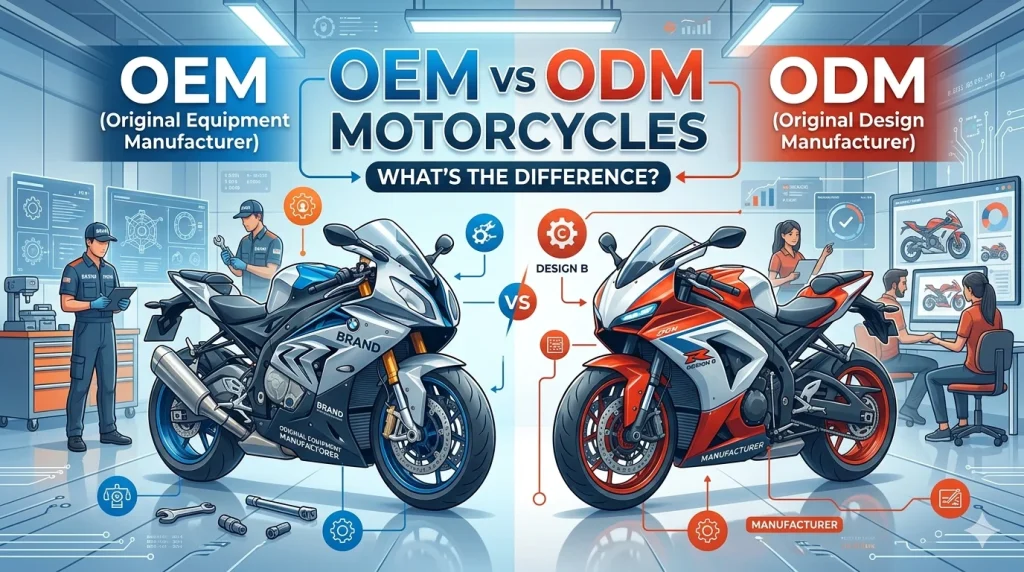
OEM vs ODM Motorcycles : The Main Difference
The simplest way to understand the difference is this:
- OEM is usually better when brand control and market differentiation matter more.
- ODM is usually better when speed, simplicity, and lower project complexity matter more.
OEM gives buyers more influence over how the final product is presented and positioned. ODM gives buyers faster access to proven product platforms with fewer development steps.
Quick Comparison: OEM vs ODM Motorcycles
| What buyers compare | OEM | ODM |
|---|---|---|
| Branding flexibility | Higher | Moderate |
| Development complexity | Higher | Lower |
| Time to launch | Slower | Faster |
| Customization depth | Stronger | More limited |
| MOQ pressure | Often higher | Often more manageable |
| Engineering coordination | More involved | Less involved |
| Fit for new distributors | Depends | Often better |
| Fit for established brand strategy | Strong | Moderate |
This is why there is no universal answer. The better model depends on the buyer’s actual commercial goal.
When OEM Is the Better Choice
OEM usually makes more sense when the buyer already has a clear market plan and wants to develop stronger brand differentiation.
OEM may be the better choice if:
- you already have an established distribution network
- you want stronger control over brand presentation
- you want motorcycles that better reflect your local market strategy
- you have stable volume expectations
- you can support a longer development and approval process
For example, a dealer group building a long-term private label strategy may prefer OEM because it offers more control over product identity and channel consistency.
OEM is often more suitable for buyers who are planning beyond the first shipment and thinking about long-term brand value.
When ODM Is the Better Choice
ODM is often the better option when speed and operational efficiency matter more than deep customization.
ODM may be the better choice if:
- you want to enter the market quickly
- you are testing demand before scaling
- you want to reduce development complexity
- you do not need extensive engineering changes
- you prefer using a proven model platform
For many first-time importers or developing distributors, ODM offers a faster path to market with lower coordination pressure. Instead of building too much too early, buyers can start with a practical product range and refine their strategy as sales data becomes clearer.
That is why ODM is often a strong entry model for new regional distributors.
Cost, MOQ, and Lead Time: What Buyers Should Expect
One reason buyers choose ODM is that it often reduces early-stage cost and coordination pressure. Since the supplier already has a product platform, the launch process is usually more efficient.
In general:
- OEM may require more time for confirmation, branding, specification alignment, and sample approval.
- ODM may allow quicker selection, adaptation, and production scheduling.
- OEM projects may involve higher MOQ depending on customization scope.
- ODM projects may be easier to start at moderate volume, depending on the supplier and product category.
However, buyers should not rely on assumptions. They should ask the supplier directly:
- What is the MOQ for standard ODM models?
- What changes are possible under OEM?
- What affects lead time the most?
- Which customizations increase cost significantly?
- What is the sample process before production?
A reliable supplier should answer these clearly and realistically.
Related: How to Audit Motorcycle OEM Factory Before Your First Order
Customization: How Much Is Actually Possible?
This is where many buyers misunderstand OEM and ODM.
Some suppliers say they offer OEM and ODM, but when buyers ask for practical details, the customization scope is still vague. That is why the discussion should always move from general terms to specific options.
Buyers should clarify whether the supplier can support:
- branding and logo placement
- color changes
- decals and appearance updates
- packaging customization
- accessories or selected part changes
- seat height or utility-focused configuration adjustment
- market-specific communication materials
The key question is not whether the supplier says “yes” to OEM or ODM. The key question is whether the supplier can explain exactly what is changeable, what is standard, and what requires engineering review.
Which Model Fits Different Types of Buyers?
The right answer often depends on the buyer type.
New Importers
New importers often benefit from ODM because it is faster, simpler, and easier to manage. It allows them to test sales and build local understanding before committing to a larger branded strategy.
Growing Distributors
Growing distributors may start with ODM and move toward OEM once they understand which models perform best and how they want to position their brand.
Established Dealer Groups
Dealer groups or regional brands with stronger market control often prefer OEM because it supports long-term differentiation and stronger identity in the channel.
Buyers Serving Specific Market Niches
If the buyer focuses on a niche such as urban commuter motorcycles, delivery-use cub motorcycles, or specific regional preferences, the decision depends on whether fast execution or brand-specific adjustment matters more.
A Practical Decision Framework
If you are unsure which model fits your business, ask these questions:
- Do you need to launch quickly, or can you invest more time in preparation?
- Is branding a strategic priority in your market?
- Do you already understand which motorcycle specifications sell best?
- Are you testing demand or scaling an existing distribution network?
- Can you support the longer coordination cycle that OEM may require?
- Is a proven platform enough for your current business stage?
If your answers focus on speed, lower complexity, and faster validation, ODM is often the better starting point. If your answers focus on differentiation, private label growth, and long-term control, OEM is often the stronger model.
Common Buyer Mistakes
When comparing OEM and ODM motorcycles, buyers often make a few avoidable mistakes.
Mistake 1: Choosing OEM Too Early
Some buyers want full customization before they have validated local demand. This can create unnecessary cost and slow the launch.
Mistake 2: Treating ODM as Low Value
ODM is not a weak option. For many distributors, it is the most practical way to enter the market with lower risk.
Mistake 3: Not Defining Customization Scope Clearly
If branding, packaging, or component changes are not defined early, misunderstandings can affect both timeline and cost.
Mistake 4: Ignoring Spare Parts and After-Sales Support
The supply model matters, but after-sales capability still determines long-term success.
Mistake 5: Focusing Only on Unit Price
The better project is often the one with clearer execution, better communication, and stronger product-market fit, not simply the cheapest quotation.
Questions to Ask a Motorcycle Supplier About OEM and ODM
Before moving forward, buyers should ask:
- What is included in your OEM service?
- What is included in your ODM service?
- Which changes are standard and which require engineering review?
- What is the MOQ for each option?
- How long does sampling and approval usually take?
- What documents and support are provided during production?
- How are spare parts handled for OEM and ODM models?
- Which product categories are most suitable for each supply model?
If the supplier cannot explain these points clearly, buyers should investigate further.
What a Strong OEM/ODM Manufacturing Partner Looks Like
A strong supplier should be able to connect product capability with business execution.
That usually means the manufacturer can explain:
- product categories and market fit
- export experience
- branding and customization options
- sample confirmation process
- production planning
- compliance communication
- spare parts and after-sales support
This is where factory profile and public positioning matter. Suppliers that clearly communicate manufacturing identity, export reach, and B2B service capability tend to make buyer evaluation easier. KAMAX, for example, emphasizes factory-based manufacturing, OEM/ODM support, and global distributor-oriented supply across several motorcycle categories KAMAX.
Conclusion
OEM and ODM motorcycles are not competing labels. They are two different business paths for different stages of market development.
OEM is usually the better fit when buyers want stronger brand control, deeper customization, and long-term market differentiation. ODM is usually the better fit when buyers want faster launch, lower development complexity, and a more efficient entry path.
For importers, distributors, and dealer groups, the key is to match the supply model to the real business objective. The best decision is not the one that sounds more advanced. It is the one that fits your market, your resources, your timeline, and your growth strategy.
FAQ
What is the main difference between OEM and ODM motorcycles?
OEM usually focuses more on buyer-specific branding and customization, while ODM usually relies on an existing product platform that can be adapted more quickly and with less development complexity.
Is OEM always better than ODM for distributors?
No. OEM offers more control, but ODM is often faster and easier to launch. For many distributors, especially newer ones, ODM may be the more practical choice.
Is ODM a good option for first-time motorcycle importers?
Yes. ODM is often a good starting point because it reduces early-stage complexity and helps buyers enter the market faster with a proven platform.
Does OEM always mean full motorcycle redesign?
No. In many B2B motorcycle projects, OEM may involve branding, graphics, packaging, and selected configuration changes rather than full engineering redesign.
How should buyers compare OEM and ODM offers from suppliers?
They should compare MOQ, lead time, branding flexibility, customization scope, sample process, technical support, spare parts planning, and communication clarity.
Can a distributor start with ODM and move to OEM later?
Yes. This is a common path. Many distributors begin with ODM to test the market, then move toward OEM once they have clearer sales data and brand direction.
Not sure whether OEM or ODM is right for your market?
Talk with our team about your target customers, preferred motorcycle category, branding goals, and launch timeline.