
The first container often reaches dealers before a regular spare-parts replenishment cycle has been established. A missing filter, brake component, mirror or model-specific electrical part can therefore take longer—and cost more—to resolve.
A shipment may contain motorcycles that are ready for sale, but the distributor also needs enough support to complete pre-delivery work, respond to early service requests and handle selected transport or assembly issues.
A first shipment motorcycle spare parts package does not need to cover every future repair. It needs to protect the market launch until regular forecasting and replenishment begin.
Quick Answer
A first shipment motorcycle spare parts package should account for:
- expected service demand during the launch period;
- the number of models and technical configurations;
- parts shared across compatible motorcycles;
- parts unique to one engine, brake or electrical configuration;
- transport and handling exposure;
- CBU, SKD or CKD shipment format;
- local workshop capability;
- international replenishment lead time;
- packing evidence and shortage-claim procedures.
Do not calculate the package only as a percentage of the motorcycle order. First identify which missing items could stop dealer delivery, workshop service or local assembly before the next shipment arrives.
About this Page
Who This Guide Is For
This guide is intended for motorcycle distributors, importers, dealer groups, CKD/SKD assemblers and private-label buyers preparing an initial commercial shipment from China.
It assumes that the models and main commercial terms are already under discussion. Buyers still reviewing the wider sourcing process can first read How to Import Motorcycles from China.
The focus here is what should be confirmed before the first container closes.
First Shipment Spare Parts Checklist
The package is easier to control when parts are grouped by purpose.
| Package Area | Typical Items | Planning Basis | Evidence Before Shipment |
|---|---|---|---|
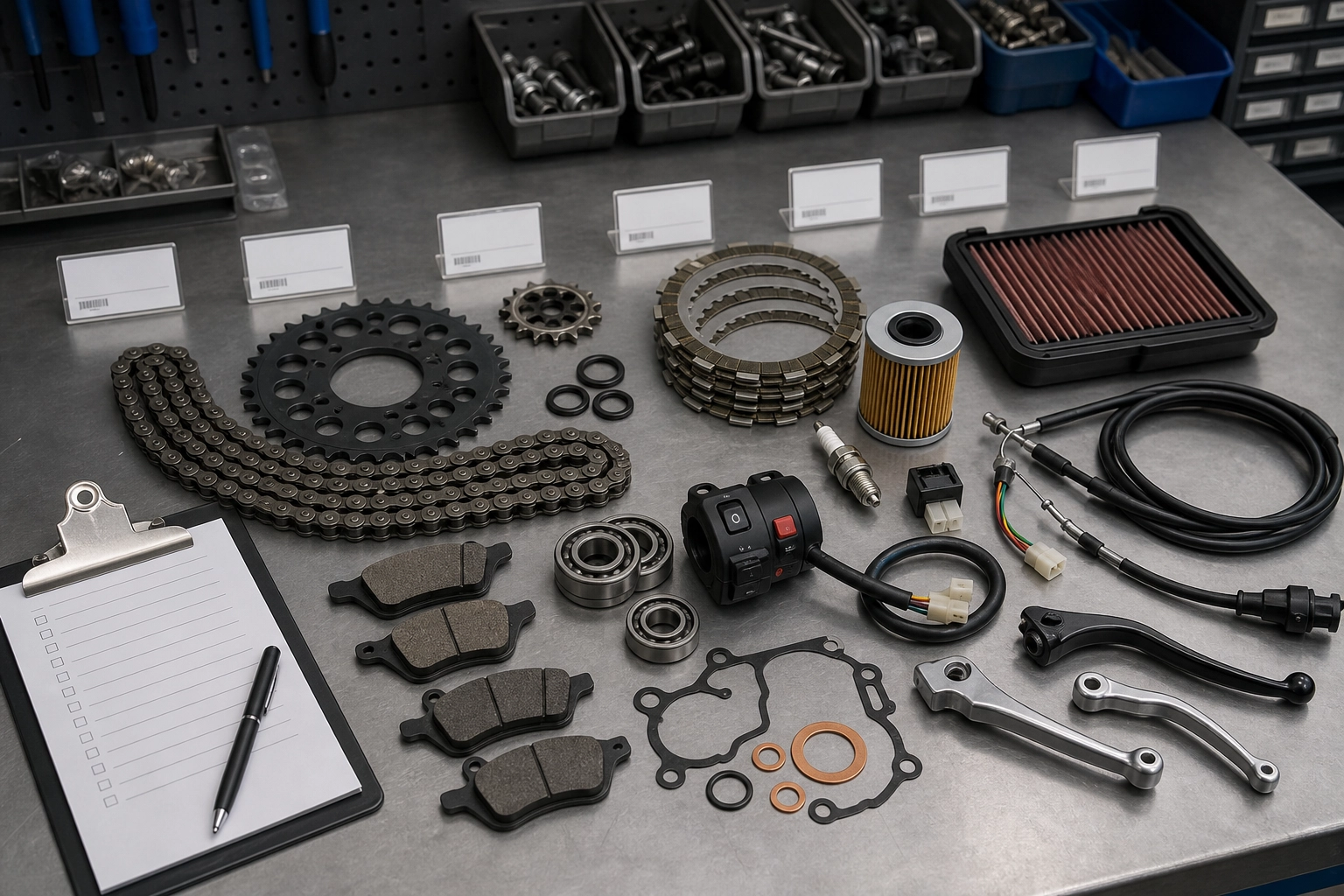
| Fast-moving service parts | Brake pads, filters, cables, bulbs, chains, sprockets and selected seals | Expected demand before replenishment | Part number, compatible model and packing list |
| Launch-protection parts | Mirrors, lamps, levers, covers, selected plastics and small hardware | Transport exposure and pre-delivery risk | Carton identification and packing photos |
| Model-specific critical parts | EFI components, controllers, brake parts and unique electrical items | Model quantity and downtime risk | Model-to-part compatibility record |
| Common-platform parts | Shared filters, pads, cables, switches and engine-service parts | Combined compatible volume | Approved common-parts list |
| SKD or CKD assembly support | Coded fasteners, fittings, replacement hardware and shortage kits | Local assembly and handling-loss risk | Bag codes, BOM references and assembly checklist |
| Documentation | Manuals, labels, parts catalogues and model references | Market and shipment requirements | Approved document list |
| Claim-control records | Carton IDs, packing photos, loading records and reporting contacts | Agreed shortage and damage procedure | Pre-shipment release file |
This is a planning framework, not a universal packing list. Final quantities must follow the approved motorcycles, configurations and local service plan.
Start With Launch Risk, Not Only Unit Count
Many buyers begin by asking:
How many spare parts should we buy with 60 or 100 motorcycles?
Unit count is useful, but it does not show how difficult the shipment will be to support.
A shipment of 100 motorcycles built around one engine and brake platform may require fewer distinct part lines than a 60-unit shipment divided across three unrelated models.
The smaller order may contain:
- different engines;
- EFI and carburetor versions;
- different braking systems;
- different filters and brake pads;
- different lamps, instruments or body panels;
- different wheels, tires or batteries.
The buyer should review four risks:
Service interruption
Which parts are likely to be needed during pre-delivery inspection, early maintenance or workshop service?
Delivery interruption
Which visible, functional or safety-related parts could prevent a motorcycle from being handed over?
Model variation
Which parts fit several motorcycles, and which fit only one technical configuration?
Replenishment delay
How long will the distributor wait if a replacement must be prepared and shipped internationally?
For long-term stock and reorder planning, see Motorcycle Spare Parts Planning for Distributors.
Long-term planning supports a product throughout its market life. The first shipment package only needs to protect the opening stage.
Build the Package in Four Layers
1. Fast-Moving Service Parts
This layer covers parts most likely to be requested during setup and early service.
Depending on the motorcycle, it may include:
- brake pads or shoes;
- air, fuel and oil filters;
- clutch, throttle and brake cables;
- chains and sprockets;
- spark plugs;
- bulbs and selected electrical parts;
- tire tubes and valves;
- common switches;
- selected seals and gaskets.
Do not copy one generic list across every motorcycle. Match each line to an approved part number and compatible model.
Two brake pads may look similar but use different dimensions. Two filters from the same engine supplier may not fit the exact engine versions in the order.
2. Launch-Protection Parts
Some parts have low normal turnover but are vulnerable during transport, unloading or workshop handling.
Examples include:
- mirrors;
- levers;
- lamps and turn signals;
- instrument covers;
- footrests;
- mudguards;
- selected side covers;
- exposed brackets;
- small fittings and fasteners.
Prioritize items that are exposed, difficult to repair locally or capable of stopping retail handover.
There is usually no need to load every painted panel in every color. Select the pieces most likely to be affected by the actual packing and handling method.
3. Common-Platform and Model-Specific Parts
Mixed-model orders require two separate calculations.
Common-platform parts
These parts fit more than one model or configuration, such as shared:
- filters;
- brake pads;
- cables;
- switches;
- bearings;
- engine-service parts.
Pool these items against the total number of compatible motorcycles—not the total number of motorcycles in the container.
Model-specific parts
These parts fit only one model, engine or technical configuration.
Examples include:
- a particular EFI component;
- a model-specific ECU;
- an ABS component;
- a unique headlamp or instrument;
- a specific rear brake part;
- a model-specific wheel;
- a unique body panel.
Calculate these lines against the relevant model quantity and the operational effect of the part being unavailable.
| Part Number | Description | Compatible Model | Configuration | Initial Quantity |
|---|---|---|---|---|
| Supplier reference | Clear English name | Model name or code | EFI, carburetor, ABS, CBS or other variation | Approved quantity |
4. CBU, SKD and CKD Support
Shipment format changes the support requirement.
CBU
CBU motorcycles normally require less local assembly. The package can focus on service parts, transport-exposed items and model-specific critical components.
SKD
SKD shipments require stronger control over removed parts and local reassembly. Review:
- coded fasteners;
- replacement hardware;
- assembly instructions;
- loose-part identification;
- shortage-reporting records;
- parts easily damaged during assembly.
CKD
CKD projects require close control between the bill of materials, packing units and local assembly stages.
The package may include:
- coded small-parts bags;
- replacement fittings;
- assembly consumables;
- parts-location references;
- exploded views;
- stage-specific shortage kits;
- technical support records.
See Motorcycle CKD vs SKD vs CBU Explained for a broader comparison.
Illustrative Example: A Hypothetical Mixed-Model Order for Russia
Consider a hypothetical Russian distributor preparing an initial order of 60 motorcycles across three models:
- 24 units of Model A;
- 20 units of Model B;
- 16 units of Model C.
Models A and B use the same commuter platform and share front brake pads and oil filters. Model C uses a different EFI system and rear brake configuration.
Calculating every spare part against all 60 motorcycles would create an inaccurate package.
| Parts Group | Applicable Quantity | Planning Approach |
|---|---|---|
| Shared brake pads and filters for Models A and B | 44 motorcycles | Pooled against their combined compatible volume |
| EFI and rear brake parts for Model C | 16 motorcycles | Calculated separately as model-specific critical parts |
| Mirrors, lamps and exposed parts | Each model separately | Reviewed against packing and handling exposure |
| General workshop consumables | Entire launch program | Based on expected early service demand |
| Replenishment-sensitive parts | By model | Reviewed against replacement lead time |
This approach avoids ordering duplicate common parts while leaving Model C without support for its unique EFI and rear brake system.
It also makes warehouse receiving easier. Shared components can be stored as common platform stock, while Model C parts remain separately labeled.
Pool parts only after compatibility has been confirmed. Protect unique configurations separately.
How to Decide Initial Quantities
There is no reliable global percentage for every first motorcycle order.
A percentage may help with budgeting, but the package still needs a line-by-line review.
Initial quantity = expected launch demand + transport or handling reserve + warranty-response reserve + replenishment buffer
Review the following factors.
Expected launch demand
Estimate how many motorcycles will be delivered and serviced before the next parts shipment can arrive.
Use the distributor’s actual launch period—often the first 60 or 90 days—rather than treating one period as an industry rule.
Compatible motorcycle volume
Calculate common parts against the motorcycles they actually fit.
Do not calculate a shared filter against all 60 units if it fits only 44.
Configuration differences
Check variations in:
- engine displacement;
- EFI or carburetor;
- brake system;
- ABS or CBS;
- wheels;
- tires and tubes;
- batteries;
- lamps;
- instruments;
- body parts.
Each confirmed variation may create a separate spare-parts requirement.
Downtime impact
Some components have low expected consumption but high operational importance.
A model-specific ECU, EFI component or brake part may rarely fail, but one unavailable item can keep a motorcycle out of service until an international replacement arrives.
A small reserve may therefore be justified even when expected turnover is low.
Transport exposure
Calculate mirrors, lamps, levers and exposed body parts according to how the motorcycles are packed and handled.
The same allowance should not be applied to a protected component and a part positioned near the edge of a crate.
Complete replenishment time
Include:
- order confirmation;
- factory preparation;
- export consolidation;
- international transport;
- customs clearance;
- domestic delivery.
The relevant lead time is the complete recovery period, not only the factory production time.
Local repair capability
A standard fastener or locally available bearing may not require the same reserve as a proprietary controller, painted cover or model-specific instrument.
Set Three Working Priorities
To keep the package focused, divide the list into three working levels.
Level 1: Launch-Critical Parts
These can stop delivery, service or local assembly.
Examples include:
- critical brake parts;
- model-specific electrical parts;
- EFI or ignition components;
- non-substitutable assembly hardware;
- exposed items with known handling risk.
Review these first, even when forecast consumption is low.
Level 2: Routine Service Parts
These have more predictable workshop turnover.
Examples include filters, pads, shoes, cables, plugs, chains, sprockets, bulbs and selected seals.
Calculate them according to expected demand and replenishment time.
Level 3: Special-Order Parts
These are normally large, expensive or infrequently requested.
Examples may include:
- major engine assemblies;
- complete wheels;
- large painted panels;
- high-value electronic assemblies.
They can usually remain available through factory replenishment unless market distance, service commitments or known risks justify local stock.
Adjust the Package by Motorcycle Type
| Motorcycle Type | Typical First-Package Emphasis |
|---|---|
| Cub and commuter motorcycles | Brake parts, cables, chains, sprockets, filters, lamps and exposed covers |
| Scooters | CVT service parts where applicable, brakes, electrical items, lamps and selected plastics |
| Off-road and utility motorcycles | Levers, controls, chains, sprockets, filters and impact-exposed parts |
| Electric motorcycles | Model-specific electrical parts, approved charging items, controllers and diagnostic support |
| SKD and CKD projects | Coded fasteners, small fittings, assembly references and shortage kits |
The category guides the review. The approved model specification remains the final reference.
Packing and Identification
A spreadsheet does not prove that the parts entered the container.
The packing list should identify:
- part number;
- clear description;
- compatible model;
- applicable configuration;
- quantity;
- unit of measure;
- carton number;
- quantity per carton;
- gross and net weight where required.
Avoid descriptions such as “motorcycle parts,” “maintenance kit” or “one set of spare parts.” They are difficult to verify during receiving and provide little value during a shortage investigation.
Label the cartons
A carton label can include:
- purchase order or shipment number;
- motorcycle model or platform;
- parts category;
- carton sequence;
- gross weight;
- handling information.
Keep model-specific items separated or clearly divided inside mixed cartons. The warehouse team should not need to open every box to identify compatibility.
Include spare parts in the release evidence
Pre-shipment inspection often focuses on finished motorcycles. Spare-parts cartons also need verification.
Useful records include:
- open-carton photos;
- visible part labels;
- carton identification;
- sealed-carton photos;
- pallet position;
- packing-list references;
- loading photos where agreed.
The IMO/ILO/UNECE Code of Practice for Packing of Cargo Transport Units provides broader guidance for packing and securing cargo transport units.
The commercial spare-parts checklist does not replace cargo-safety requirements. It adds product identification and shipment verification to the process.
Define Claim Responsibility Before Loading
A missing part and a failed part are not the same claim.
Separate the following situations:
Factory shortage
An approved item was not packed.
Packing or production error
The wrong part, specification or quantity was supplied.
Transit damage
The item was packed but damaged during transport.
Local assembly loss
The item arrived but was misplaced or damaged during SKD or CKD assembly.
Dealer or workshop handling
The part was lost or damaged after receiving.
Warranty failure
The original installed component failed under the agreed warranty conditions.
Agree in advance on:
- required photos;
- part-number evidence;
- carton and shipment reference;
- reporting deadline;
- responsible contact;
- technical review process;
- replacement approval;
- replacement shipping method.
Clear definitions allow genuine factory shortages to be processed faster and prevent local handling losses from being treated automatically as production claims.
How KAMAX Reviews a First-Shipment Parts Package
1. Freeze the motorcycle configuration
Confirm the final:
- model;
- engine;
- fuel system;
- brakes;
- ABS or CBS specification;
- wheels;
- electrical configuration;
- shipment format.
The parts list should not be finalized while motorcycle specifications are still changing.
2. Separate shared and unique components
Match each proposed part to:
- one model;
- several compatible models;
- one technical configuration;
- the full shipment.
This determines whether quantities can be pooled.
3. Review launch and replenishment risk
Confirm:
- expected launch volume;
- dealer and workshop structure;
- likely service demand;
- local repair capability;
- next shipment timing.
4. Confirm packing identification
Connect the approved parts list to carton numbers, labels and shipment evidence.
5. Establish the after-arrival contact path
Confirm who receives:
- shortage reports;
- warranty claims;
- compatibility questions;
- replenishment requests.
The goal is not to stock every available part. It is to establish a controlled starting package and a clear route for the next order.
Supplier preparation should also be assessed together with production capability, export documentation, quality control and communication. See How Importers and Distributors Can Choose a Reliable Motorcycle Manufacturer in China.
Common Mistakes
| Situation | Better Approach | Risk if Left Open |
|---|---|---|
| Calculating only by motorcycle quantity | Review compatibility, service risk and replenishment time | Small missing parts interrupt delivery |
| Using one generic package for several models | Separate common and model-specific parts | One model remains unsupported |
| Listing parts without part numbers | Confirm part numbers and compatibility | Incorrect ordering and workshop errors |
| Packing SKD/CKD hardware without codes | Match bags and cartons to assembly references | Shortage disputes and assembly delays |
| Excluding spare parts from shipment evidence | Photograph and identify the relevant cartons | Buyer cannot verify loading |
| Ordering routine items but no critical parts | Rank parts by downtime impact | Inventory rises without protecting the launch |
| Leaving claim responsibility undefined | Agree on evidence, timing and contacts | Every case becomes a dispute |
| Promising later support without a lead time | Confirm the replenishment route | Dealers wait without a recovery plan |
Pre-Shipment Release Checklist
Before releasing the container, confirm:
- Final models and quantities are approved.
- Technical configurations are frozen.
- Common and model-specific parts are separated.
- Fast-moving service parts are reviewed.
- Launch-protection items are reviewed.
- Critical low-frequency parts are assessed.
- SKD or CKD support is included where applicable.
- Every line has a part number.
- Compatible models are identified.
- Quantities reflect launch demand and replenishment time.
- Parts appear on the final packing list.
- Carton numbers match the packing records.
- Packing evidence covers the spare-parts cartons.
- Shortage and damage procedures are agreed.
- Factory and buyer contacts are confirmed.
- The next replenishment route is understood.
Release the shipment only when the motorcycles and the agreed support package can be verified together.
FAQ
What should be included in a first shipment motorcycle spare parts package?
A practical package normally includes routine service parts, launch-protection items, common-platform parts, model-specific critical parts, SKD or CKD support where applicable, and packing and claim-control records.
Should spare parts be calculated by motorcycle quantity?
Motorcycle quantity is one input, not the complete calculation.
Use the number of compatible motorcycles, expected demand, downtime risk, transport exposure and replacement lead time.
Is there a standard spare-parts percentage for a first order?
There is no universal percentage that works for every order.
A percentage can support budgeting, but the package still needs to be checked line by line. A mixed-model order may need more distinct support items than a larger single-platform shipment.
How does a mixed-model order affect the package?
Separate common parts from model-specific parts.
Pool shared components against the total compatible quantity. Calculate unique EFI, brake, electrical or body parts against the model that uses them.
Do SKD and CKD shipments need different support from CBU?
In many cases, yes.
SKD and CKD programs need stronger control over loose hardware, coded bags, assembly references and shortage reporting. CBU shipments place more emphasis on service and transport-exposed replacement parts.
What proves that the parts were packed?
Use approved part numbers, packing-list quantities, carton IDs, labels, packing photos and loading evidence where agreed.
A quotation or verbal confirmation alone does not prove that the parts were shipped.
Prepare the First Container for the Launch
The first container usually arrives before the distributor has built a stable service history, parts forecast or regular reorder cycle.
A well-planned package helps the distributor:
- complete dealer preparation;
- respond to early service needs;
- replace selected transport-damaged items;
- support each model correctly;
- investigate shortages faster;
- prepare the next order using actual market demand.
Planning a first motorcycle shipment from China?
Share your target market, motorcycle mix, technical configurations, expected launch volume and CBU, SKD or CKD requirements with the KAMAX team.
KAMAX can help review model compatibility, the first shipment spare parts package, packing identification and the follow-up replenishment plan before the container closes.
Contact KAMAX to discuss your distributor project.