
This motorcycle models first order guide helps new importers decide whether to begin with one, two or three models—and how technical variants, spare parts and supply formats affect that decision.
For many new importers, the safest starting point is one core motorcycle model. Two models can also work when they target clearly defined customer groups and share manageable component, service and spare-parts requirements. Three models may be practical for an importer with an established warehouse, dealer network and after-sales process, but they should not be treated as the default.
The right decision depends on more than showroom variety. Your business must be able to identify, receive, sell, service and reorder every approved configuration without relying on memory, scattered messages or incomplete quotation files.
A focused first shipment normally produces clearer market feedback and creates a stronger foundation for future orders.
Importers who have not yet decided which motorcycle categories fit their market should first read How to Choose the Right Motorcycle Models for Your Local Market.
Motorcycle Models First Order: Quick Answer
A new motorcycle importer should generally begin with:
- One model when local demand, supplier execution or after-sales readiness is still being tested.
- Two models when each product has a clear market role and the support requirements remain manageable.
- Up to three models when the importer already has reliable product control, warehouse separation, dealer training and spare-parts planning.
- Four or more models only when mature systems are already in place.
However, model names alone do not show the real complexity of an order. Engine options, brake systems, colors, wheels, branding and packing formats can turn one model into many operational combinations.
On This Page
Model Count Is Not the Same as SKU Count
Before selecting a first-order range, importers should distinguish between a model, a variant and an SKU.
Model
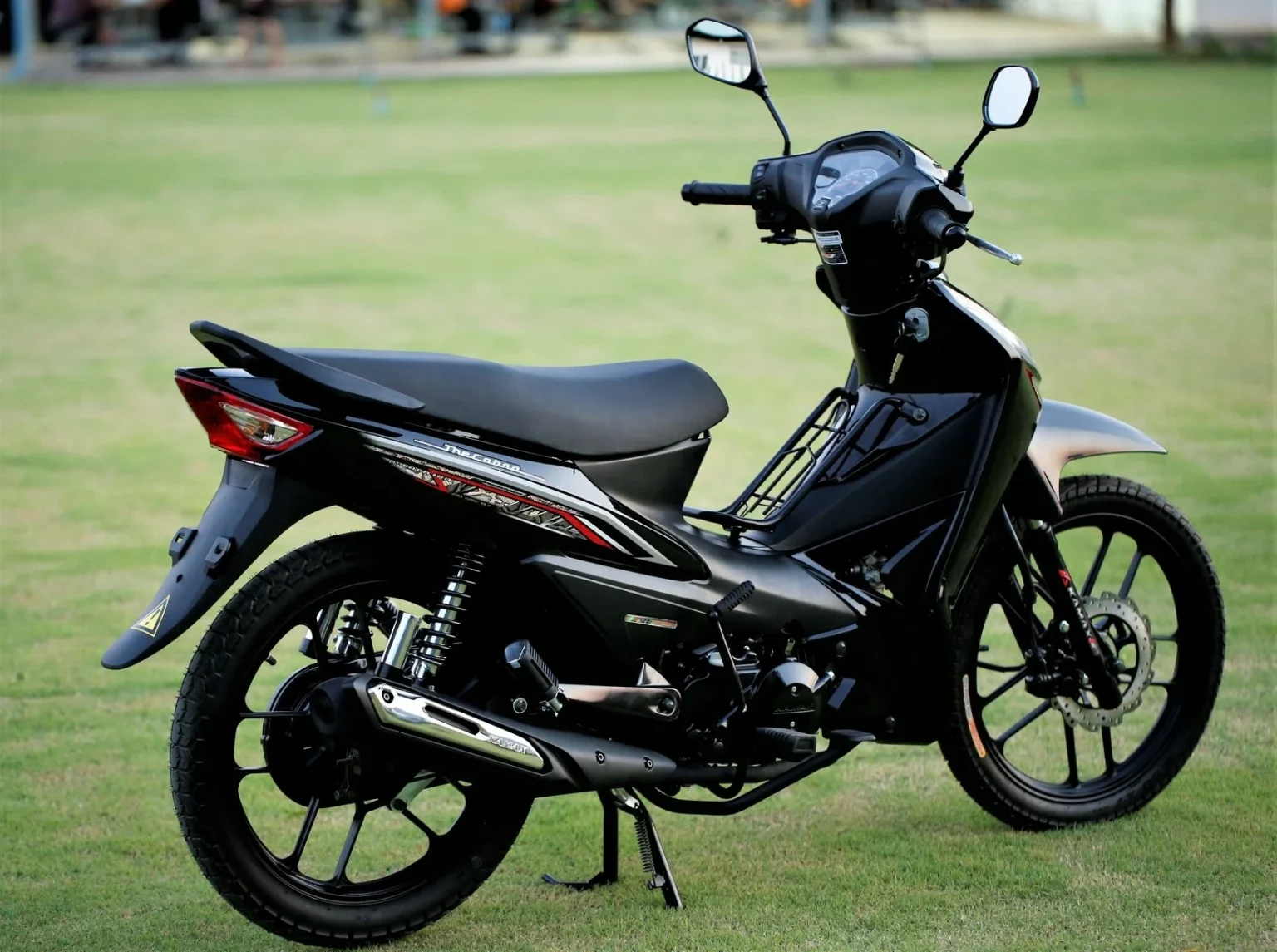
A model is the commercial motorcycle family, such as a 125cc cub, city commuter, scooter or delivery-focused motorcycle.
Variant
A variant is a technical version of the model. Variants may differ by:
- Engine displacement
- EFI or carburetor
- Front disc and rear drum brakes
- Front and rear disc brakes
- ABS or CBS
- Cast or spoke wheels
- Instrument and lighting packages
- Accessories and rear carriers
- CBU, SKD or CKD supply format
SKU
An SKU is the actual combination that must be produced, identified, packed, received, stocked and supported.
For example, one model with:
- Two engine configurations
- Two brake configurations
- Three colors
can create up to 12 practical combinations before wheel options, branding, accessories or packing formats are included.
That order may be more difficult to manage than two models with one fixed specification each.
New importers should therefore control the number of operational SKUs, not only the number of model names shown in the quotation.
One, Two or Three Models: First-Shipment Comparison
| Launch Range | When It Fits | Main Advantage | Main Risk | What Must Be Ready |
|---|---|---|---|---|
| One model | New importer, one clear buyer segment or limited service experience | Simplest product, parts and launch control | The sales team may feel the range is narrow | One frozen specification, parts list and receiving process |
| Two models | Two confirmed market needs with manageable platform differences | Better coverage without full-line complexity | Documentation, parts and training begin to multiply | Clear positioning and preferably shared components |
| Three models | Importer already has basic operational and after-sales discipline | Broader launch while remaining controllable | Demand and support resources may become fragmented | Stable naming, packing separation and launch ownership |
| Four or more | Usually more appropriate after the first sales cycle | Wider showroom selection | Diluted quantities, weaker reorder data and greater support pressure | Mature operating systems rather than first-order improvisation |
The first shipment should function as a controlled market launch, not as a miniature product catalog.
Importers who are still deciding whether the purchase is a sample, trial or commercial order should also review Motorcycle Sample Order, Trial and Bulk Orders. Each order stage should answer a different business question before the range or volume expands.
What Every Additional Model Adds
Adding another model affects much more than the product range.
| Business Area | What an Additional Model May Add |
|---|---|
| Product control | More specifications, option sheets and approval records |
| Production | More components, colors and scheduling variables |
| Documentation | Additional manuals, labels, model codes and certificates |
| Packing | More crate, carton and spare-parts identification |
| Warehouse | More receiving and inventory separation |
| Dealer support | More product explanations and technician training |
| After-sales | More filters, cables, brake parts and body components |
| Reordering | Lower volume per configuration and less reliable demand signals |
A product may be commercially attractive, but the importer still needs to control its technical specification, documentation, warehouse identity and after-sales requirements.
Every additional model should therefore have a clear reason for being included.
When One Motorcycle Model Is the Best Choice
One model is usually the strongest first-shipment strategy when the importer is still proving:
- Local market demand
- Supplier execution
- Product quality consistency
- Dealer acceptance
- Warehouse receiving procedures
- Mechanic and after-sales readiness
- Reorder potential
A focused launch creates one clear product story and one manageable support system.
For example, a distributor launching a 125cc cub for everyday commuting can concentrate on:
- One engine family
- One approved brake configuration
- One wheel and tire specification
- One manual and label set
- One fast-moving spare-parts package
- One dealer-training process
The importer can then evaluate customer questions, product performance, parts demand and dealer feedback without too many variables changing at once.
A one-model launch is particularly suitable when:
- The company is entering motorcycle distribution for the first time
- The dealer network is still small
- Local mechanics are unfamiliar with the selected products
- Spare-parts inventory has not yet been established
- Homologation costs are significant
- The supplier relationship has not yet been tested through a complete commercial order
- The business may later move from CBU to SKD or CKD
The goal of the first shipment is not simply to fill a container. It should help the importer learn how the product moves through quotation approval, production, shipping, receiving, sales and after-sales support.
When Two Models Are Manageable
Two models can be a practical first-order range when the second product has a clear commercial purpose.
Manageable combinations may include:
- A commuter motorcycle and a cargo-focused version
- A 110cc cub and a 125cc cub built around a similar platform
- Two commuter models serving different price levels
- A commuter and a basic scooter when urban and regional sales channels are already separated
Two models are easier to support when they share:
- Engine architecture
- Filters, cables or brake components
- Wheels and tires
- Electrical components
- Similar service procedures
- The same assembly and packing format
The second model becomes risky when it introduces a completely separate engine family, body system, spare-parts inventory, manual set and mechanic-training requirement.
Before adding it, confirm that the product expands useful market coverage without creating an entirely separate operating system.
When Three Models Can Work
Three models may be suitable when the importer already has basic launch discipline.
The range should have:
- A clearly defined customer segment for each model
- Stable model names and approved specifications
- Enough quantity to evaluate demand for each product
- Confirmed manuals, labels and homologation requirements
- A warehouse process for separating units and parts
- Dealers who understand how each product should be positioned
- A defined spare-parts plan
- A clear person responsible for each launch workstream
Three models are less suitable when variety is being used to compensate for uncertain market positioning.
For example, when the importer does not yet know whether the market prefers cubs, scooters or manual commuters, placing all three categories in the same first shipment will not remove the uncertainty. It will spread that uncertainty across inventory, dealer training, technical support and future reordering.
A broader range only creates useful market intelligence when the business can measure and compare each model properly.
Which Model Combinations Create More Complexity?
Not every product combination creates the same operational burden.
Cub + Cub
This can be relatively manageable when both motorcycles share a similar frame, engine platform, service parts and customer position.
A 110cc cub and a 125cc cub may therefore be easier to support than two unrelated motorcycle categories.
Importers considering this category can review the current KAMAX Cub motorcycle range to compare different displacement, commuting and light-adventure options.
Commuter + Commuter
This combination can work when the products serve different price points or riding needs while maintaining disciplined engine, brake and parts specifications.
The models should have clear commercial roles. For example, one may serve entry-level daily transport while the other offers stronger load capacity or a higher specification.
Cub + Scooter
This creates more separation because the products may have different:
- Riding controls
- Transmission systems
- Body panels
- Service procedures
- Customer expectations
- Dealer presentation
- Spare-parts requirements
The combination may still be commercially valid, but it requires stronger preparation.
Commuter + Scooter + Cargo Model
This is a significantly heavier first launch.
The importer is effectively creating several small product-support systems at the same time. Without an established warehouse, dealer network and technical team, this range may become difficult to control.
Importers comparing several product categories can use the KAMAX wholesale motorcycle range to review cub, commuter, scooter, dual-sport, street, electric and off-road options before narrowing the first shipment.
Two Models Can Be Easier Than One Fragmented Model
Consider two different first-order plans.
Example A: One Model With Too Many Variants
An importer selects one commuter model with:
- EFI and carburetor versions
- Two brake configurations
- Three colors
- Cast and spoke wheel options
- Both CBU and SKD packing
Although the order contains only one model name, the factory and importer may need to control many specification, packing and identification combinations.
The warehouse must distinguish them. Dealers must understand them. Spare parts must match them. Future purchase orders must identify the correct combinations.
Example B: Two Models With Fixed Specifications
Another importer orders:
- One 125cc cub
- One 125cc commuter
- One fixed brake configuration for each
- One color for each
- Standard CBU packing
- A shared group of fast-moving parts
The second order contains two models but fewer operational variables.
This is why two controlled models may be easier to manage than one highly fragmented model.
How CBU, SKD and CKD Affect the Decision
The supply format changes how much product variety a new importer can manage safely.
CBU
CBU motorcycles arrive as complete units. The importer mainly controls:
- Unit identity
- Visible specification
- Crate condition
- Labels and documents
- Warehouse receiving
CBU does not remove complexity, but it is normally the simplest format for a new importer.
SKD
SKD requires stronger grouping and assembly-side identification.
The importer must make sure that:
- Sub-assemblies are linked to the correct model
- Hardware and body components are separated
- Assembly instructions match the approved specification
- Labels and parts packs are easy to identify
- The local assembly team understands the model differences
CKD
CKD places much greater pressure on the warehouse and assembly operation.
Engines, frames, wheels, electrical parts, hardware, body panels, labels and manuals must all be grouped and identified correctly.
As the supply format becomes more complex, the first-order range should usually become narrower.
For a detailed comparison of assembly level, logistics, local labor and quality-control responsibilities, read Motorcycle CKD vs SKD vs CBU Explained.
Spare Parts Must Be Planned Before the Range Is Approved
Every added model may introduce different:
- Oil and air filters
- Brake pads or shoes
- Control cables
- Chains and sprockets
- Electrical components
- Wheels and tires
- Plastic and body-color parts
- Manuals and parts catalogs
A shipment can arrive complete and still create commercial problems if dealers cannot identify the correct service parts.
Before approving the model mix, confirm:
- Which fast-moving parts belong to each model
- Which components are shared
- Which parts will ship with the motorcycles
- How the warehouse will identify them
- How dealers will reorder them
- Who will maintain the parts cross-reference
The importer does not need a large spare-parts warehouse immediately, but it does need a controlled identification and reorder system.
For a more detailed planning framework, read Motorcycle Spare Parts Planning for Distributors.
Homologation Can Make a Small Range More Complex
Model count should also be reviewed together with local compliance requirements.
Two motorcycles that look similar may still require different approval work because of differences in:
- Engine displacement
- ECU and fuel system
- Emissions configuration
- Brake equipment
- Lights, mirrors and reflectors
- Tires
- VIN and label format
- Intended road or off-road use
Adding a technical variant after the homologation process has started can affect documentation, testing, labels and launch timing.
Before placing the order, the importer should confirm:
- The destination country
- Intended use
- Required certificate or approval pathway
- Exact model and variant
- Label and VIN requirements
- Documents available from the manufacturer
- Local registration responsibility
For a full compliance checklist, see the Motorcycle Homologation Guide: EEC, EPA, CCC and OTTS.
Commercial Terms Do Not Fix an Unclear Model Mix
A low MOQ, attractive price or flexible payment term does not make an uncontrolled product range safer.
The importer should freeze the following information before production:
- Final model codes
- Quantity by model
- Technical specifications
- Color split
- Accessories
- Manuals and labels
- Spare-parts scope
- CBU, SKD or CKD format
- Packing marks
- Delivery responsibility
The U.S. International Trade Administration explains that Incoterms define the tasks, costs and risks assigned to buyers and sellers. Incoterms can clarify who manages freight, insurance, customs and delivery stages, but they do not define the motorcycle specification or solve model-identification problems.
The same principle applies to payment. The International Trade Administration’s Methods of Payment guide explains the different risk positions created by cash in advance, letters of credit, documentary collection and open-account arrangements. Whichever method is selected, the buyer still needs a clear and executable product file.
For motorcycle-specific commercial controls, read Motorcycle MOQ, Lead Time and Payment Terms for Import Orders.
Mixed-Model Shipments Need Clear Packing and Identification
A mixed-model shipment should not depend on workers recognizing products by appearance alone.
The packing plan should show:
- Model code
- Color
- Configuration
- Quantity
- Crate or carton mark
- Loose-parts identification
- Spare-parts package
- Loading position where necessary
This becomes increasingly important in SKD and CKD projects.
The World Shipping Council notes in its Container Integrity guidance that poor packing practices can contribute to internal cargo collapse, container-stack problems and other transport incidents.
For motorcycle importers, proper shipment control should therefore cover both physical cargo security and accurate product identification.
Practical First-Shipment Readiness Checklist
Review the following questions before confirming production:
| Question | Yes | No |
|---|---|---|
| Does every model serve a confirmed customer segment? | ||
| Can dealers explain the differences between the models clearly? | ||
| Do the models share an engine or parts platform? | ||
| Are technical variants limited and clearly named? | ||
| Are colors and option combinations controlled? | ||
| Are manuals and labels finalized for every approved version? | ||
| Can the warehouse identify every unit and parts pack? | ||
| Can local mechanics service every model? | ||
| Are fast-moving spare parts assigned to each model? | ||
| Is the quantity sufficient to evaluate demand by model? | ||
| Can the correct configuration be reordered from approved files? | ||
| Is the selected CBU, SKD or CKD format suitable for the local operation? | ||
| Has homologation been reviewed for every configuration? | ||
| Are packing marks and shipment separation clearly defined? |
A few unresolved items may be manageable. A large number of “No” answers usually indicates that the order should be simplified, documented more clearly or divided into phases before production begins.
This checklist supports operational review. It does not replace local market research, homologation analysis, legal advice or commercial due diligence.
KAMAX Factory Perspective
Founded in 2001, KAMAX manufactures and exports motorcycles for international distributors, importers, dealers and OEM/ODM partners.
Across CBU, SKD and CKD projects, the most stable first launches usually have:
- A clearly identified core model
- Frozen technical specifications
- Limited configuration combinations
- Consistent model names across commercial documents
- A defined fast-moving spare-parts plan
- Clear packing and receiving identification
- A measurable plan for evaluating the next order
Factories can produce broad product ranges, but first-order execution becomes more reliable when the buyer and manufacturer agree on which products are genuine launch priorities.
Clear decisions at the beginning reduce late specification changes, document inconsistencies, packing confusion and incorrect reorders.
Importers who need a wider overview of the sourcing process can also read How to Import Motorcycles from China.
Final Recommendation
For most new motorcycle importers:
- Begin with one core model when demand, service readiness or supplier execution is still being tested.
- Add a second model only when it serves a clear market need and remains manageable within the same operating system.
- Consider three models only when the warehouse, dealer network and after-sales process are already prepared.
- Count actual engine, brake, wheel, color, branding and packing combinations—not only model names.
- Keep SKD and CKD first shipments narrower than comparable CBU projects.
- Confirm homologation before finalizing technical variants.
- Finalize manuals, labels, parts and receiving logic before production.
- Use the first shipment to generate reliable market evidence for the next purchase.
A strong first range is one the importer can launch properly, support consistently and reorder accurately.
Plan a More Controlled Motorcycle Launch
KAMAX supports motorcycle importers, distributors and dealer groups with:
- Model selection
- Configuration planning
- OEM and ODM cooperation
- CBU, SKD and CKD supply
- Spare-parts preparation
- Export documentation coordination
- Long-term distributor support
To review a proposed first-order range, provide:
- Target country
- Planned motorcycle categories
- Estimated order quantity
- Preferred engine displacement
- Required brake and wheel configurations
- CBU, SKD or CKD preference
- Current dealer and service capacity
- Required certification or homologation pathway
The KAMAX export team can help assess whether the proposed range is practical for production, receiving, after-sales support and future reorders.
Review My First-Order Model Mix
Frequently Asked Questions
Should a new importer begin with one motorcycle model?
In many cases, yes. One model makes it easier to test market demand, supplier execution, warehouse receiving, dealer response and after-sales readiness before expanding the range.
Is ordering two motorcycle models too many for a first shipment?
Not necessarily. Two models can work when each has a clear commercial role and the products share manageable service or spare-parts requirements. Risk increases when they require completely separate engines, parts and technical training.
Is one model with several configurations still a simple order?
Not always. One model with several engines, brake systems, wheels, colors and packing formats may create more operational SKUs than a two-model order with fixed specifications.
Does CBU, SKD or CKD affect how many models should be ordered?
Yes. CBU is generally easier to receive because the motorcycles arrive as complete units. SKD and CKD require stronger parts identification, warehouse control and assembly preparation, so the range should usually be narrower.
Why do mixed-model orders complicate spare-parts planning?
Every additional model can introduce different filters, cables, brake components, electrical parts and body items. Without clear cross-references, dealers may struggle to identify and reorder the correct parts.
When should an importer expand the model range?
Expansion should follow actual sales and service data. Add models after the first cycle shows which customer segments are buying, which specifications are preferred, which parts are required and which products dealers can support confidently.