Choosing a reliable motorcycle manufacturer in China is one of the most important decisions for importers, distributors, and dealer groups. The right supplier should do more than offer a competitive price. It should support your business with stable quality, export experience, compliance capability, spare parts planning, and reliable communication from inquiry to shipment.
For many B2B buyers, the real risk is not the quotation itself. The real risk comes later, when product quality varies, documentation is incomplete, spare parts are delayed, or the supplier cannot support the market after the first order. That is why supplier selection should be treated as a long-term business decision, not just a purchasing task.
China remains one of the world’s key sourcing bases for cub motorcycles, commuter motorcycles, dual sport motorcycles, street motorcycles, and OEM or ODM projects. Manufacturers that present clear factory identity, export capability, and structured distributor support are usually in a stronger position to serve global B2B buyers. Public positioning also matters. For example, KAMAX presents itself as a China motorcycle manufacturer focused on wholesale and OEM/ODM cooperation, with multiple product categories and global export reach KAMAX .
Related: OEM vs ODM Motorcycles: Which Model Fits Your Market?
Key Takeaways
Before selecting a motorcycle supplier in China, importers and distributors should confirm five things:
- The company is a real manufacturer with clear production capability.
- The supplier has export experience relevant to the target market.
- Product compliance, documentation, and communication processes are clear.
- OEM/ODM capability is practical, not just promotional language.
- Spare parts, after-sales support, MOQ, and lead time are transparent.
If several of these areas remain vague after early communication, buyers should slow down and verify more before placing a large order.
Why Choosing the Right Manufacturer Matters
In motorcycle B2B, supplier quality affects far more than procurement cost. It influences dealer confidence, market launch speed, after-sales performance, and brand reputation.
A supplier with weak production control or poor coordination can create costly downstream problems:
- inconsistent product quality
- delayed shipment
- missing documents
- spare parts shortages
- warranty disputes
- pressure on distributors and local dealers
For that reason, experienced buyers do not evaluate a factory based on price alone. They evaluate the supplier’s ability to support the business over time.
Related Source:
How to Audit Motorcycle OEM Factory Before Your First Order
Motorcycle OEM Southeast Asia: How to Build Your Brand with Manufacturers
Step 1: Confirm Whether the Supplier Is a Real Factory
One of the first questions buyers should ask is whether the company is an actual manufacturer or mainly a trading company.
A real factory usually has stronger control over production scheduling, customization, technical communication, and quality management. That does not mean every factory is reliable, but it does mean buyers have a clearer path to verify capability.
Look for evidence such as:
- company history and manufacturing background
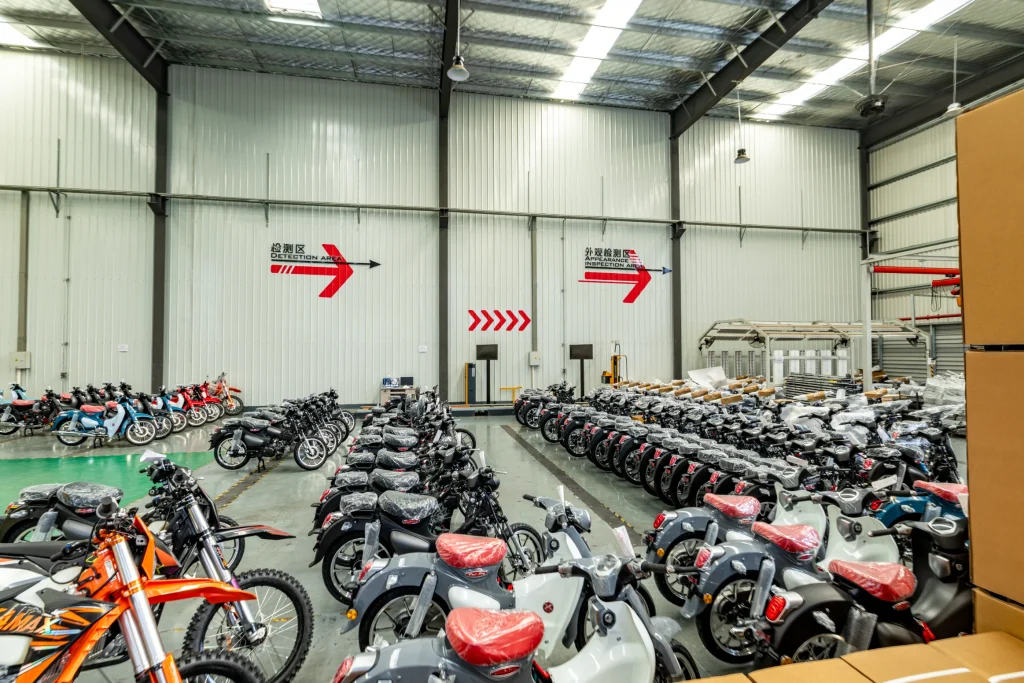
- production line photos or factory videos
- product categories with consistent focus
- export market references
- OEM or ODM service explanation
- clear description of factory capacity or production workflow
If the supplier only speaks in general marketing language and avoids operational details, that is a warning sign.
Factory vs Trading Company: Quick Comparison
| What buyers should check | Factory | Trading company |
|---|---|---|
| Production control | Direct | Usually indirect |
| Customization coordination | Stronger | Depends on upstream factory |
| Technical communication | More direct | Can be slower or less precise |
| Delivery scheduling visibility | Better | Often limited |
| Ability to solve production issues | Usually stronger | Depends on factory partner |
A trading company is not automatically a bad choice, but B2B buyers looking for long-term OEM, private label, or distributor cooperation often prefer more direct factory access.
Step 2: Review Export Experience and Market Understanding
A motorcycle that works well in one region may not fit another. Road conditions, rider expectations, emissions requirements, service conditions, and distributor structure differ widely across markets.
That is why export experience matters. A reliable supplier should understand more than just the product. It should understand market use cases.
Ask questions like:
- Which countries or regions do you currently export to?
- What motorcycle categories are strongest in those markets?
- How do you recommend choosing between cub, commuter, or dual sport models?
- What support do you provide for new distributors?
- How do you help buyers plan spare parts and documentation?
Suppliers with real export experience usually ask better questions too. They want to know who the buyer is, what customer segment they serve, how the bikes will be used, and what regulations apply. That is often a sign of a more mature B2B manufacturer.
Step 3: Evaluate Product Consistency and Quality Control
A motorcycle manufacturer should be able to explain how quality is managed, not just show attractive model photos.
For distributors and importers, product consistency is critical because even small problems become expensive when multiplied across many units. One unstable shipment can damage dealer trust and slow market growth.
Ask for details on:
- incoming material inspection
- assembly process control
- engine testing
- electrical system testing
- pre-shipment inspection
- packaging standards for export
- handling process for quality claims
A reliable supplier should also be comfortable discussing sample evaluation and trial order arrangements. If quality control cannot be explained clearly, buyers should be cautious.
Step 4: Check Compliance and Documentation Support
For global B2B buyers, compliance is not optional. Even a good motorcycle product can become a business problem if the supplier cannot support the required documentation or explain what standards the model meets.
Depending on the destination market, buyers may need support related to:
- emissions requirements
- homologation or market-specific compliance
- VIN-related documentation
- technical specifications
- commercial invoice and packing list consistency
- shipping and customs support documents
For buyers serving Europe or compliance-sensitive markets, this is especially important. Publicly, KAMAX emphasizes international standards and Euro 3, EEC, EPA, OTTS, Euro 5+ positioning, which are exactly the kinds of trust signals many importers look for during early supplier evaluation KAMAX.
The key question is simple: can the supplier clearly explain what it can provide, what is standard, and what depends on the destination country?
Step 5: Verify Whether OEM and ODM Capability Is Real
Many suppliers say they support OEM and ODM, but buyers should verify what that actually means in practice.
In general:
- OEM usually refers to manufacturing with the buyer’s brand, selected specification, or market-facing customization.
- ODM usually refers to adapting an existing product platform for a buyer who wants speed, flexibility, or lower development complexity.
When evaluating OEM or ODM capability, ask whether the supplier can support:
- logo and branding
- color and graphics
- packaging customization
- selected component changes
- market-oriented feature adjustment
- sample approval process
- communication during pre-production
A reliable manufacturer will explain not only what is possible, but also what is realistic in terms of MOQ, engineering limits, lead time, and production cost.
Step 6: Review Spare Parts and After-Sales Support
This is one of the most overlooked areas in motorcycle sourcing, but it is one of the most important for long-term success.
For distributors, a motorcycle sale does not end at shipment. Spare parts supply, technical communication, and service support often determine whether the model can scale in the local market.
Ask the supplier:
- Do you provide recommended spare parts lists for first orders?
- How are parts packaged and identified?
- What is the replenishment cycle?
- Do you provide service documents or manuals?
- How are warranty or technical issues communicated?
In many markets, dealer satisfaction depends as much on parts support as on the motorcycle itself. Buyers who choose suppliers based only on initial price often discover this too late.
Step 7: Confirm MOQ, Lead Time, and Delivery Stability
A professional motorcycle manufacturer should be transparent about execution, not only product selling points.
Before moving forward, buyers should confirm:
- MOQ for standard models
- MOQ for OEM or ODM projects
- sample policy
- lead time in normal season
- lead time in peak season
- container loading planning
- shipment coordination process
- payment terms and milestone expectations
Factories with stable export routines are usually clearer and more realistic here. Suppliers who overpromise on speed or flexibility often create problems later.
Quick Factory Audit Checklist for Importers
Before choosing a motorcycle manufacturer in China, buyers should be able to verify the following:
- Is the company a real factory with visible production capability?
- Does the supplier have export experience in your target region?
- Can it explain product quality control clearly?
- Does it understand compliance and documentation requirements?
- Is OEM or ODM support defined in practical terms?
- Is spare parts planning included in the business discussion?
- Are MOQ, lead time, and shipment terms transparent?
- Is communication timely, specific, and consistent?
If the answer to several of these questions is unclear, it is usually better to keep evaluating rather than rush into a large-volume order.
A Common Buyer Mistake: Choosing by Price Alone
One common mistake among first-time importers is focusing too heavily on the lowest quotation.
In practice, a lower initial price can lead to higher total cost if the supplier has weak packaging standards, unstable quality, poor documentation support, or no spare parts system. Buyers may save money on paper but lose time, dealer trust, and after-sales efficiency after shipment.
That is why experienced distributors usually compare suppliers across several dimensions:
- product consistency
- export communication
- technical support
- compliance readiness
- parts support
- delivery reliability
Price matters, but it should be evaluated together with operational risk.
Red Flags Buyers Should Watch For
Be cautious if a supplier:
- cannot clearly explain whether it is a factory
- avoids detailed questions about compliance or documentation
- gives vague answers about spare parts
- promises unrealistic lead times
- focuses only on price, not market fit
- cannot explain the OEM or ODM process
- provides inconsistent information between sales messages and product documents
These issues do not automatically mean the cooperation will fail, but they are signals that more verification is needed.
What a Strong Motorcycle Manufacturing Partner Usually Looks Like
Reliable B2B manufacturers often have several common traits:
- clear factory identity
- focused product categories
- export experience across multiple markets
- structured OEM or ODM support
- practical understanding of distributor needs
- consistent communication
- willingness to discuss parts, compliance, and after-sales early
Manufacturers that position themselves around long-term B2B cooperation tend to communicate these strengths more clearly. KAMAX, for example, publicly emphasizes factory manufacturing, OEM/ODM support, global export coverage, and product categories such as cub, commuter, and dual sport motorcycles, all of which are relevant signals for importers screening suppliers KAMAX .
Conclusion
Choosing a reliable motorcycle manufacturer in China requires a structured evaluation process. The best supplier is not simply the one with the lowest price, but the one that can support stable product quality, export coordination, compliance awareness, spare parts planning, and long-term business growth.
For importers, distributors, and dealer groups, supplier selection should be treated as a strategic decision. A strong manufacturing partner can help reduce operational risk, improve dealer support, and create a stronger market position over time.
The best place to start is simple: verify factory capability, review export experience, confirm compliance support, understand OEM or ODM limits, and make sure after-sales and spare parts planning are part of the conversation from the beginning.
FAQ
How do I know if a motorcycle supplier in China is a real factory?
Check whether the company can clearly present its manufacturing background, production lines, product focus, export experience, and customization process. A real factory should be able to explain operations in practical detail.
Is it better to work directly with a factory or with a trading company?
For many B2B buyers, direct factory cooperation offers stronger visibility into production, customization, and technical communication. However, the key is not the label alone. Buyers should verify actual capability and service quality.
What documents are usually needed to import motorcycles from China?
This depends on the market, but buyers often need commercial documents, technical specifications, and support related to compliance, emissions, or registration requirements. A reliable supplier should explain what it can provide clearly.
How important is spare parts support when choosing a motorcycle manufacturer?
It is extremely important. Spare parts availability affects dealer confidence, customer satisfaction, maintenance efficiency, and long-term product success in the local market.
Is OEM or ODM better for a new distributor?
That depends on the market strategy. OEM may fit buyers who want stronger branding control, while ODM may be more practical for distributors who want faster launch and lower development complexity.
What is a normal MOQ for motorcycle wholesale orders?
MOQ varies by model, project type, and whether the order is standard, OEM, or ODM. Buyers should always confirm MOQ together with lead time, sample arrangements, and customization scope.
Looking for a motorcycle manufacturing partner in China?
Talk with our team about your target market, preferred motorcycle category, OEM or ODM needs, and distributor support requirements.