
Scooters are known for simplicity.
No clutch lever.
No gear shifting.
No stalling in traffic.
But that simplicity is made possible by a mechanical component that most riders never see — the centrifugal clutch.
In over two decades of scooter manufacturing and drivetrain development, we’ve learned something important:
When customers complain about vibration, weak acceleration, overheating, or burning smell — the root cause often begins in the clutch system, not the engine.
This article explains how a scooter centrifugal clutch really works, why failures happen in the market, and what separates a stable OEM-grade clutch from a low-cost alternative.
You will Learn
1. What Is a Scooter Centrifugal Clutch?
A centrifugal clutch is an automatic mechanical engagement device used in almost all CVT scooters.
Its function is simple but critical:
- Disconnect engine power at idle
- Gradually engage torque as RPM increases
- Automatically disengage during deceleration
It operates purely on centrifugal force and spring resistance — no electronics, no rider control.
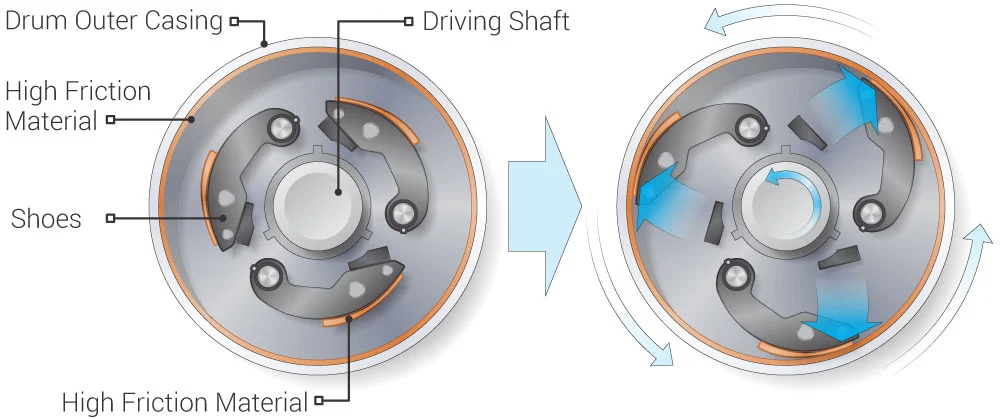
The clutch assembly is integrated with the rear pulley of the CVT transmission and transfers torque to the final drive system once engagement occurs.
2. Internal Structure: Why Manufacturing Precision Matters
From the outside, a clutch assembly appears simple. Internally, however, performance depends heavily on material consistency and machining accuracy.
A standard scooter centrifugal clutch consists of:
2.1 Clutch Shoes
Usually three evenly spaced friction shoes mounted on a central carrier.
Each shoe includes:
- A friction lining
- A steel or aluminum base
- A tension spring connection
When RPM increases, centrifugal force pushes these shoes outward until they contact the clutch bell.
What determines durability here?
- Friction material formulation
- Bonding strength between lining and shoe
- Weight consistency between shoes
- Thermal stability
Even slight imbalance between shoes can cause low-speed vibration (judder).
In our production control process, shoe weight variation is strictly limited to ensure engagement consistency.
2.2 Clutch Bell (Drum)
The clutch bell rotates with the rear pulley.
Its inner surface becomes the torque transfer interface.
Common failure causes in lower-quality units:
- Poor roundness tolerance
- Uneven heat treatment
- Surface glazing under high temperature
- Deformation after prolonged load
Once roundness tolerance is compromised, vibration becomes unavoidable.
This is why CNC machining accuracy and controlled heat treatment are critical — not optional.
2.3 Clutch Springs
Springs control engagement RPM.
Typical engagement range: 2500–3500 RPM (model dependent).
Weak or inconsistent springs cause:
- Early engagement
- Slipping under load
- Overheating
Overly stiff springs cause:
- Aggressive take-off
- Rider discomfort
- Increased drivetrain shock
Spring fatigue resistance is often overlooked, but in long-term durability testing, spring consistency directly affects performance stability.
3. How a Scooter Clutch Works in Real Riding Conditions
Let’s move beyond theory and describe what happens dynamically.
Idle State (Disengaged)
Engine speed: ~1500–1800 RPM.
Centrifugal force is insufficient to overcome spring tension.
Clutch shoes remain inward.
No contact with clutch bell.
Rear wheel remains stationary.
If idle RPM is improperly adjusted, the scooter may creep forward — often misdiagnosed as clutch failure.
Engagement Phase (Take-Off)
Throttle opens → RPM rises.
Centrifugal force increases exponentially.
Shoes begin contacting the bell surface.
This stage is progressive, not instant.
If friction material quality is inconsistent, you feel:
- Shudder
- Noise
- Jerky motion
Smooth engagement depends on uniform friction contact and accurate spring calibration.
Full Engagement (Cruising)
Shoes fully expand and press firmly against the bell.
Torque transfer becomes stable.
At this stage, clutch design influences:
- Heat resistance
- Load capacity
- Long-term wear rate
Delivery fleets and cargo use cases place the highest stress here.
Disengagement (Deceleration)
RPM drops.
Centrifugal force decreases.
Springs retract shoes inward.
Power disconnects automatically.
This prevents engine stalling and reduces drivetrain stress.
4. Why Scooter Clutches Fail in the Market
Based on export market data and warranty analysis, most clutch issues fall into three categories:
4.1 Clutch Slipping
Symptoms:
- High RPM, slow acceleration
- Burning odor
- Reduced climbing ability
Primary causes:
- Worn friction lining
- Oil contamination inside CVT housing
- Weak springs
- Poor heat resistance
Heat buildup is the most common long-term damage factor.
4.2 Take-Off Vibration (Judder)
Extremely common in budget-level scooters.
Root causes:
- Uneven shoe wear
- Bell surface irregularity
- Thermal deformation
- Shoe weight imbalance
Precision control during manufacturing dramatically reduces this issue.
4.3 Overheating Under Heavy Load
High ambient temperature + stop-and-go traffic + cargo load
= continuous partial engagement.
This generates excessive heat.
Without adequate material quality and ventilation design, friction surfaces glaze quickly and service life drops significantly.
5. What Defines an OEM-Grade Centrifugal Clutch?
For distributors and private-label buyers, price alone is not a reliability indicator.
Key quality benchmarks include:
- Friction material density and composition
- Bonding durability under heat cycling
- Clutch shoe balance tolerance
- Clutch bell roundness (CNC verified)
- Heat treatment hardness consistency
- Spring fatigue life testing
- Dynamic balance verification
A $3 cost difference in clutch assembly can translate into significantly higher warranty rates if ignored.
Brand reputation is often damaged not by engine failure — but by vibration complaints.
6. Engineering Approach to Durability
With more than 20 years in scooter manufacturing, we emphasize consistency over marketing claims.
Our validation process includes:
- Material batch traceability
- Engagement RPM calibration testing
- Long-cycle durability simulation
- Hardness and deformation inspection
- Assembly balance verification
Because drivetrain stability directly impacts rider perception of quality.
7. Service Life Expectations
Under normal urban commuting conditions:
A properly manufactured centrifugal clutch can typically operate between 15,000–25,000 km or more.
Service life depends heavily on:
- Rider load
- Traffic conditions
- Ambient temperature
- Maintenance frequency
Heat control is the single biggest factor influencing longevity.
8. Frequently Asked Questions
What RPM does a scooter clutch engage?
Typically between 2500 and 3500 RPM depending on spring setup.
Why does my scooter shake when starting?
Most commonly caused by uneven clutch shoe wear or clutch bell surface irregularity.
Can clutch quality affect fuel efficiency?
Indirectly, yes. Excessive slipping increases energy loss and reduces transmission efficiency.
How often should a scooter clutch be inspected?
Inspection is recommended during CVT belt replacement or every 10,000–15,000 km depending on usage conditions.
Final Thoughts
The centrifugal clutch may appear simple.
But in reality, it is one of the most sensitive components in the scooter drivetrain system.
Smooth take-off, durability under load, and long-term reliability all depend on manufacturing precision, material quality, and engineering control.
For OEM buyers and distributors, understanding these details helps reduce after-sales risk and improve brand perception in competitive markets.
If you are developing scooter models or sourcing for private label projects, drivetrain stability should be part of your evaluation checklist.