
About the Article
For a motorcycle distributor, choosing between a 125cc and a 150cc Cub is not simply a question of engine size.
It affects market access, retail positioning, dealer margin, product overlap, homologation, spare-parts planning and reorder potential.
A 150cc model may offer stronger performance but still create a weaker business case if the retail premium is difficult to defend. A 125cc model may look less powerful on paper yet reach a larger customer base, sit more naturally in the price ladder and produce faster dealer sell-through.
125cc vs 150cc Cub Motorcycles: The decision should therefore start with the market and the business model, not the engine catalogue.
Quick Answer
For distributors, 125cc usually has the stronger case when licensing access, commuter volume and a lower retail position matter most. A 150cc Cub makes more sense when customers can clearly feel the performance or equipment upgrade and the market can support the higher landed cost and retail price.
The decision should be based on:
Market access → Customer use → Retail economics → Portfolio role → After-sales complexity
—not displacement alone.
| Decision Area | 125cc Cub | 150cc Cub |
|---|---|---|
| Typical role | Core commuter / accessible lifestyle | Step-up commuter / lifestyle / performance |
| Customer reach | Often broader where 125cc has licensing or regulatory advantages | More dependent on local displacement and licence rules |
| Retail position | Entry-to-core price band | Core-to-premium price band |
| Performance expectation | Daily urban and suburban use | Stronger load, acceleration and mixed-road expectation |
| Dealer story | Accessibility, practicality and operating economy | Performance, equipment and upgrade value |
| Portfolio role | Volume / core model | Step-up / premium model |
| Main commercial risk | Too close to lower-cost 100–110cc products | Higher cost without enough additional customer value |
Start With the Market, Not the Engine
A common sourcing mistake is to begin with the manufacturer’s available displacement options.
The distributor sees a 125cc version and a 150cc version, requests two quotations and starts comparing FOB prices.
That comes too early.
Before selecting displacement, define the commercial environment:
- target customer;
- local licence structure;
- displacement-related registration or tax rules;
- realistic retail price;
- main competitors;
- passenger and load use;
- road conditions;
- expected dealer margin;
- and the models already sitting in the distributor’s lineup.
This matters because the same 25cc difference can have very different consequences in different markets.
A 150cc model may give a noticeable performance improvement, but if it moves outside an important licence category and into a much more competitive retail band, its addressable market may actually become smaller.
The opposite can happen with 125cc. If a distributor already has a basic 100–110cc commuter, another low-spec 125cc may add little to the lineup.
Displacement only becomes commercially useful when the motorcycle has a clear job inside the portfolio.
Why 125cc Can Have a Structural Market Advantage
In some markets, 125cc is not merely an engine size. It is a defined regulatory and commercial category.
The European Union is a clear example.
Under the EU driving-licence framework, Category A1 includes motorcycles with:
engine capacity not exceeding 125cc, maximum power not exceeding 11kW, and a power-to-weight ratio not exceeding 0.1kW/kg.
A 150cc motorcycle therefore exceeds the A1 displacement ceiling even if its power output remains relatively modest.
For a distributor, that can affect:
- the potential rider base;
- dealer sales qualification;
- marketing position;
- competing models;
- and the retail price strategy.
This does not mean that 125cc is automatically the better product for every European market. National market conditions still matter.
It means that licensing should be evaluated before the product is selected, not after the specification and purchase price have already been agreed.
The same principle applies elsewhere. Depending on the country, displacement can influence registration, taxation, insurance, homologation or licence eligibility.
Compare the Motorcycle, Not the Badge
Engine capacity alone is not enough to predict whether a customer will experience a meaningful difference between two motorcycles.
The distributor should compare the complete package:
power and torque, curb weight, gearing, fuel system, ECU calibration, cooling system, brakes, tyre dimensions, passenger load and intended riding conditions.
A well-matched 125cc platform can be more convincing in daily use than a 150cc model whose chassis and powertrain have not been developed around the same customer need.
The case for 150cc becomes stronger when the market involves frequent passenger use, heavier loads, hills, mixed urban-rural roads or higher average road speeds.
But the improvement needs to be tangible.
If a dealer cannot demonstrate the difference during a test ride or explain it clearly on the showroom floor, the larger displacement alone is unlikely to support a strong premium.
Build the Retail Economics Before Freezing the Specification
FOB price is only one part of the decision.
The product needs to work through the entire commercial chain:
Factory cost → Landed cost → Distributor economics → Dealer economics → Retail price → Sell-through
A useful way to work backwards is:
Maximum Acceptable Landed Cost
Target retail revenue, net of applicable sales taxes
– required dealer gross margin
– required distributor gross margin
– local PDI, warranty, marketing and operating reserves
= maximum acceptable landed cost
The exact calculation will differ by market and commercial structure, but the principle is important:
decide what the market can support before allowing the specification to determine the price.
For a 150cc upgrade, another useful calculation is:
Commercial Headroom for the Upgrade
Achievable retail premium
– incremental landed cost
– incremental homologation / parts / warranty cost
= remaining commercial headroom
If the additional retail value is quickly consumed by the additional cost, there may be little room left for the distributor or dealer.
That is a warning sign even if the 150cc motorcycle is technically superior.
Build a Price Ladder, Not Two Similar Motorcycles
Assume the distributor already sells:
110cc — Entry / value commuter
A logical Cub portfolio might then be:
110cc — Entry / value
↓
125cc — Core / premium commuter
↓
150cc — Performance / lifestyle step-up
The important point is not the exact structure. It is that every model should have a reason to exist.
Problems appear when the 125cc and 150cc:
- look almost identical;
- have nearly the same equipment;
- target the same buyer;
- and sit very close together at retail.
The dealer is then left trying to justify a higher price largely through the additional 25cc.
That is rarely enough.
For a 150cc model to occupy a genuine step-up position, the customer may also expect differences in areas such as braking, tyres, suspension, styling, equipment or overall usage proposition.
Likewise, a 125cc model should not automatically become a stripped-down version.
Where 125cc is the main market category, a well-equipped 125cc can be the strongest product in the lineup.
Benchmark the Retail Market Before Comparing Factory Quotations
Before requesting the final production quotation, compare the proposed motorcycle against several actual retail competitors.
Do not benchmark displacement alone.
| Benchmark | What the Distributor Should Review |
|---|---|
| Retail price | Where the proposed motorcycle sits against real alternatives |
| Engine | Displacement, power, torque and fuel system |
| Braking | Disc/drum, CBS, ABS and channel configuration |
| Tyres / wheels | Size, construction and market positioning |
| Equipment | Lighting, display, keyless and utility features |
| Warranty | What buyers and dealers already expect |
| Brand position | Value, mainstream, lifestyle or premium |
| Customer use | Commuting, passenger transport, utility or leisure |
| Dealer economics | Whether the target retail price leaves enough commercial room |
The purpose is not to copy competing motorcycles.
It is to understand what the market already expects at each price point.
A 150cc factory quotation may appear attractive until the distributor discovers that its resulting retail price puts it against motorcycles with ABS, better suspension, wider tyres or a stronger brand position.
That information should influence the specification before production begins.
Should You Carry Both 125cc and 150cc?
Carrying both can work well when they perform different commercial jobs.
A 125cc model may serve as the core volume motorcycle, while a 150cc version gives dealers a clear step-up product.
That structure becomes more convincing when:
| Condition | Implication |
|---|---|
| Different customer profiles | Less internal product cannibalisation |
| Clear retail-price gap | Easier dealer upsell |
| Noticeable performance or equipment difference | Customer understands why the 150cc costs more |
| Strong parts commonality | Lower after-sales complexity |
| Distinct portfolio roles | Easier inventory planning |
The case becomes weaker when the two motorcycles target the same buyer, deliver nearly the same equipment and sit at almost the same retail price.
In that situation, the second displacement may add another SKU without creating another market.
Parts Commonality Can Change the Answer
The commercial cost of adding a second model continues after the motorcycle has been sold.
Before importing both displacements, check how much they share in:
- engine family;
- EFI components;
- sensors;
- ECU architecture;
- clutch and transmission parts;
- filters;
- electrical components;
- brakes;
- wheels;
- chassis parts;
- body panels;
- and service procedures.
If the platforms share a high percentage of common service parts, a dual-displacement strategy becomes easier to operate.
If the 125cc and 150cc require substantially different engine, EFI or electrical inventories, the distributor also takes on:
more spare-parts stock, more technician training, more warranty complexity and more working capital.
For a distributor building a new dealer network, these costs can matter more than the additional catalogue width.
Go / No-Go: A Practical Distributor Decision
The following situations can help turn the analysis into an actual product decision.
| Market Situation | Decision Direction |
|---|---|
| 125cc has a meaningful licence advantage and the market is price-sensitive | Prioritise 125cc |
| 150cc increases displacement but adds little performance or equipment value | Weak case for 150cc |
| 150cc creates noticeable performance improvement and the market accepts the retail premium | Stronger case for 150cc |
| 125cc and 150cc target the same buyer at almost the same retail price | Avoid carrying both without a clearer differentiation plan |
| Both versions share the platform, service parts and a clear price ladder | Carrying both becomes easier to justify |
| 150cc requires a separate parts / EFI / service ecosystem but demand is uncertain | Use it as a controlled test model or reconsider |
| 125cc expands the addressable licence or commuter market significantly | Strong case for making it the core model |
| Dealer feedback shows customers consistently asking for more passenger/load performance | Evaluate a 150cc step-up |
The table is not a substitute for market research. It is a way to convert market information into a clearer sourcing decision.
First Order: Test a Business Hypothesis
A first order should do more than put motorcycles into warehouses and dealerships.
It should test a commercial assumption.
Instead of automatically dividing the order 50/50 between 125cc and 150cc, assign each model a role.
Core model
Expected to generate the broadest dealer sell-through.
Step-up model
Tests whether customers will pay a meaningful premium for additional performance or equipment.
Test model
Introduced at controlled volume to validate a less certain segment.
For example, a distributor may want to test:
Can our dealers sell a 150cc Cub at a sustainable premium above our core 125cc commuter without relying on heavy discounting?
That is a much more useful question than simply asking which displacement sells more units.
Sell-In Is Not the Same as Sell-Through
This distinction matters in distributor businesses.
Sell-in tells you how many motorcycles have moved from the distributor into the dealer network.
Sell-through tells you how many dealers have actually sold to end customers.
A strong launch is not defined only by sell-in.
If dealers accept the first shipment but motorcycles remain on the showroom floor for months, the product has not yet proven its market fit.
For the first order, monitor:
| Dealer Signal | What It Tells You |
|---|---|
| Customer inquiries | Initial interest |
| Test rides | Serious consideration |
| Retail conversion | Whether interest becomes sales |
| Days to sell | Sell-through speed |
| Discount required | Whether the retail price is sustainable |
| Main objections | Price, performance, specification, styling or brand barriers |
| Cross-shopping | Which products customers actually compare |
| Service / warranty cases | Early ownership risk |
| Dealer reorder request | Whether the model deserves more inventory |
The strongest signal is not usually the first shipment.
It is the ability to generate a reorder without excessive discounting or aged dealer inventory.
That is what should influence the second production order.
How KAMAX Evaluates a 125cc or 150cc Cub Project
When a distributor asks us for a 125cc or 150cc Cub, the displacement alone is not enough to recommend a model.
The information we need first usually looks like this:
| We Ask | Why It Matters |
|---|---|
| Target country | Determines licence, homologation and market constraints |
| Existing lineup | Helps avoid displacement and price overlap |
| Target retail price | Defines how much specification the commercial model can support |
| Main competitor models | Shows what equipment and performance the customer already expects |
| Primary rider use | Commuting, passenger, utility or mixed-road use changes the technical priorities |
| Expected first-order volume | Helps define whether the model is core, step-up or test |
| Dealer network and service capability | Determines how much platform complexity the distributor can absorb |
| Required margin structure | Helps establish the acceptable landed-cost ceiling |
If these variables are still unclear, it is usually too early to freeze the displacement and final technical specification.
Once the market position is defined, the project can move into engine, EFI, braking, tyres, equipment, homologation and CBU/SKD/CKD planning.
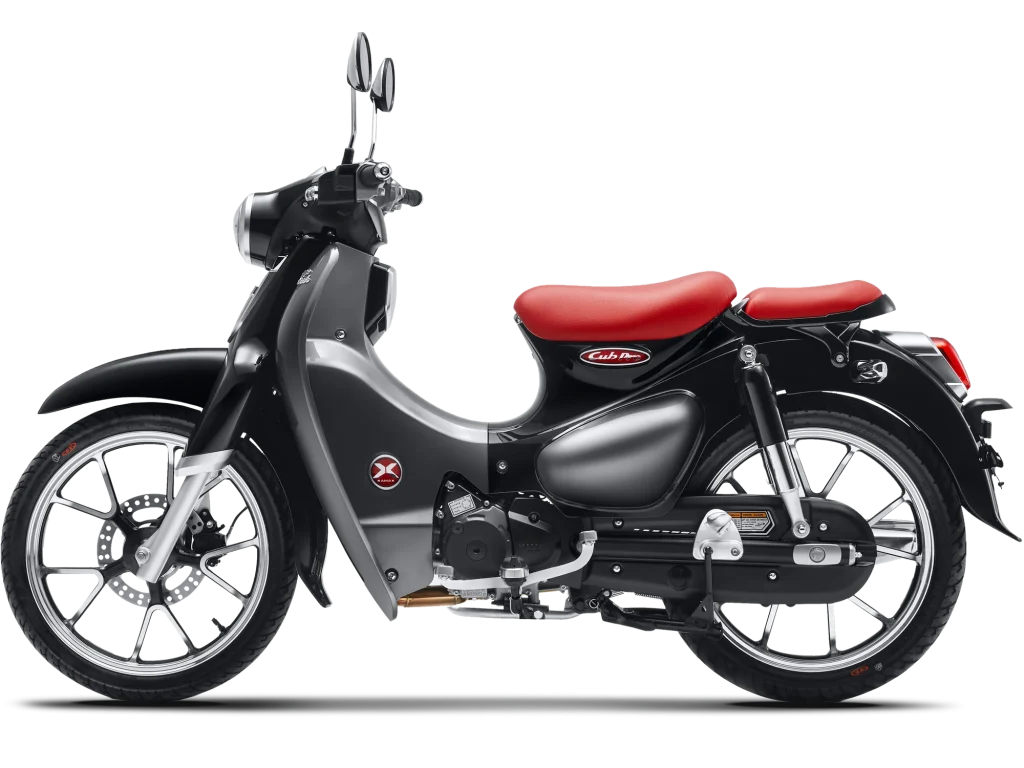
KAMAX’s current Cub Pro 125, for example, combines a 125cc platform with Bosch EFI, ABS, tubeless tyres and LED lighting, positioning the motorcycle as more than a basic low-cost commuter.
That is the broader principle behind product selection:
displacement and specification should support the intended market position together.
Before You Request the Final Quotation
Before freezing the project, the distributor should be able to answer:
- Which country and customer segment are we targeting?
- Does 125cc have a regulatory or licence advantage?
- What role does this model fill in our existing lineup?
- Which 3–5 retail motorcycles are its real competitors?
- What retail price can the market realistically support?
- What dealer and distributor margin must be protected?
- Does 150cc create enough additional customer value to justify its added cost?
- How much parts and service commonality exists between the two platforms?
- Is the model intended as core, step-up or test inventory?
- What homologation is required?
- Which sell-through indicators will determine the second order?
- What result would make us reorder, change the specification or stop the model?
If those answers are reasonably clear, the displacement decision becomes much easier.
Frequently Asked Questions
Is a 150cc Cub better than a 125cc Cub?
Not automatically.
A 150cc model may offer stronger performance, but the distributor also needs to evaluate market access, retail price, margin, customer demand, homologation and after-sales complexity.
The larger engine only creates a stronger business case when the market values the additional performance enough to pay for it.
Why is 125cc important in Europe?
The EU A1 licence category includes motorcycles with an engine capacity not exceeding 125cc, maximum power not exceeding 11kW and a power-to-weight ratio not exceeding 0.1kW/kg.
That gives 125cc particular relevance when the product is intended to reach riders within the A1 category.
Can a 150cc motorcycle qualify for the EU A1 category?
No.
The A1 definition contains a maximum engine-capacity limit of 125cc. A 150cc motorcycle exceeds that threshold regardless of whether its power remains below 11kW.
Should a distributor import both 125cc and 150cc Cub motorcycles?
Only when each model has a clear commercial role.
A common structure is to use 125cc as the core-volume motorcycle and 150cc as the performance or lifestyle step-up.
If both models target the same customer at nearly the same price, the second displacement may create more inventory and after-sales complexity than additional sales.
What matters more than displacement when selecting a Cub motorcycle?
Distributors should also compare:
power and torque, vehicle weight, engine platform, EFI and ECU, braking, tyres, homologation, landed cost, dealer margin, spare-parts commonality, customer use and expected sell-through.
The Real Decision Is Not 125cc vs 150cc
The additional 25cc matters only when it changes the business case.
For one market, a 125cc platform may provide broader licence access, faster commuter sell-through and a cleaner core-model position.
In another, customers may readily pay for the stronger performance and equipment of a 150cc step-up model.
The right choice is the one where:
market access + customer use + specification + retail economics + dealer margin + after-sales capability
all support the same product position.
That is the point at which displacement becomes commercially meaningful.
Planning a Cub motorcycle project?
Send KAMAX your target country, current lineup, target retail price, main competing models, expected order volume and preferred market position. We can review the appropriate Cub platform, specification, homologation requirements, OEM/ODM scope and CBU/SKD/CKD supply format before the production configuration is frozen. Contact us now