
About the Article
Motorcycle imports, China–India competition, retail financing and distribution economics entering 2027.
Quick Answer
What is the outlook for motorcycle distributors in the Dominican Republic in 2027?
The Dominican Republic is a substantial but competitive motorcycle market. Imports reached 267,086 units in 2025, while China remained a major supply source and Indian manufacturers strengthened their position in historical import data. Local motorcycle sales also operate within an established financing and dealer environment. For 2027, the commercial opportunities lie less in import growth alone than in competitive retail positioning, access to financing, model-level demand and inventory performance.
Research cut-off: November 17, 2026. Sources: DGII, AFAMOTO/Analytica and World Bank WITS.
Introduction
Motorcycle imports into the Dominican Republic have increased considerably since 2023, supported by an established market for personal transportation and commercial motorcycle use.
The country’s supply structure is already highly developed. Chinese motorcycles have been a major part of imports for years, Indian manufacturers have increased their historical market presence, and local dealers offer a wide selection of commuter, street and other motorcycle models.
Competition extends beyond vehicle specifications and factory prices. Consumer financing, brand positioning, parts availability and the ability to maintain retail sales influence the performance of individual products.
This review examines the Dominican motorcycle market through official registration data, historical import trends, international supply competition, published retail financing offers and distribution economics.
The emphasis is on the commercial conditions entering 2027 rather than a numerical forecast based on incomplete 2026 data.
1. Motorcycle Imports and Market Size, 2023–2026
Import Growth Has Been Substantial
According to figures from the Dirección General de Impuestos Internos (DGII), reported by Diario Libre, motorcycle imports increased from 171,503 units in 2023 to 267,086 units in 2025.
| Year | Motorcycle Imports | Annual Change |
|---|---|---|
| 2023 | 171,503 | — |
| 2024 | 244,409 | +42.5% |
| 2025 | 267,086 | +9.3% |
Source: Diario Libre, Motorcycle Import Trends, May 21, 2026, citing DGII statistics.
The strongest increase occurred in 2024, when imports grew by approximately 72,900 motorcycles. Growth moderated in 2025, but the annual volume remained at the highest level in this reported series.
Across the two years, annual imports increased by approximately 56%.
Early-2026 reporting also indicated continued import activity, although the complete 2026 annual result was not available at the research cut-off.
The increase in imports is significant. Whether it translates into sustained retail expansion depends on the pace at which dealers sell those motorcycles to end customers.
After several years of higher shipments, the relationship between importer stock, dealer inventory and retail sales becomes particularly relevant.
New Registrations Provide a Second Measure
The DGII 2025 Vehicle Fleet Report recorded 314,727 motorcycles entering the vehicle registration system for the first time in 2025, compared with 251,321 in 2024.
That represents an increase of 25.2%.
The DGII category covers new and used motorcycles receiving their first plates under the applicable procedures. It is not a direct measure of newly manufactured motorcycles sold at retail.
The same report recorded 3,846,694 motorcycles in the registered fleet at the end of 2025, accounting for approximately 57.9% of all registered vehicles.
Together, these figures demonstrate the importance of motorcycles within the country’s transportation system.
They also show why imports, first registrations and retail sales need to be treated as separate measures when assessing distribution performance.
Vehicle Age and the Existing Aftermarket
The 2025 DGII report shows that 2,994,357 registered motorcycles had manufacturing years of 2020 or earlier.
That represents approximately 77.8% of the registered motorcycle fleet.
The figure does not establish how many older motorcycles remain in regular use. It does, however, indicate a substantial population of vehicles for which maintenance and replacement-parts compatibility may remain commercially relevant.
For the aftermarket, the more useful variables are active vehicle populations, common model platforms, parts consumption and workshop coverage.
A large registered fleet provides context for the service market, but it does not establish the value of replacement demand on its own.
2. China and India: Competition in an Established Import Market
The Dominican Republic has maintained extensive motorcycle supply relationships with Asian manufacturers for many years.
One of the most notable developments in the available industry research is the change in import-origin shares.
China’s Leading Position and India’s Increasing Share
The AFAMOTO/Analytica Motorcycle Commercialization Sector Study, published in January 2025, provides the following historical comparison:
| Country of Origin | 2016 | 2019 | 2023 |
|---|---|---|---|
| China | 69.6% | 62.3% | 57.0% |
| India | 9.7% | 13.8% | 20.5% |
| Japan | 15.8% | 17.6% | 15.5% |
| Austria | 0.8% | 2.0% | 3.3% |
| Italy | 1.0% | 0.9% | 1.6% |
Source: AFAMOTO/Analytica, based on historical import-origin data from the Dominican National Statistics Office (ONE).
China remained the largest import origin in 2023, but its share had declined by 12.6 percentage points compared with 2016.
Over the same period, India’s share increased by 10.8 percentage points.
These movements describe changes in relative shares, not necessarily declines or increases in the absolute number of motorcycles shipped from each country.
Nevertheless, they reveal a more competitive international supply structure than the overall market-growth figures suggest.
What the 2025 Trade Data Shows
World Bank WITS provides a separate view of exports to the Dominican Republic under HS 871120, covering motorcycles with reciprocating internal-combustion piston engines exceeding 50cc but not exceeding 250cc.
| Exporting Country | 2025 Export Quantity | Export Value |
|---|---|---|
| China | 229,249 units | US$129.17 million |
| India | 45,282 units | US$29.84 million |
| Japan | 14,688 units | US$18.11 million |
Source: World Bank WITS, 2025, HS 871120.
These are exporter-reported figures for a specific customs classification. They form a separate trade dataset and should not be reconciled directly with the broader DGII import series.
The three listed exporters alone report more units under this classification than the total in the DGII series. Differences in coverage, reporting and trade-flow methodology therefore require attention before making direct comparisons.
The WITS figures confirm substantial continued supply from China and India but do not, by themselves, establish national retail market shares.
Competition Is About More Than Manufacturing Origin
The historical rise of Indian imports raises a commercially relevant question: which factors are supporting Indian motorcycle brands within the Dominican distribution system?
Retail price, brand recognition, financing relationships, dealer coverage and after-sales capacity may all contribute.
The published import statistics do not isolate their individual effects.
Local retail evidence, however, confirms that Indian brands such as Bajaj and Hero are present in financing-supported motorcycle listings.
For Chinese suppliers, this means competition extends beyond offering a comparable engine displacement at a lower factory quotation.
A motorcycle entering the market must compete against products already represented through local dealers, service arrangements and consumer financing channels.
The available evidence points toward a market where specific model positioning matters more than manufacturing origin alone.
3. Retail Pricing and Consumer Financing
Consumer financing is an established part of the Dominican motorcycle business.
The AFAMOTO/Analytica study estimated that motorcycle purchase loans serve more than 125,000 people annually.
It also presented an illustrative financing model based on a motorcycle valued at RD$96,308, with 85% financing, an 18-month term and a monthly interest rate of 2.5%.
The model estimated a monthly installment of RD$5,618.
These were research assumptions based on historical conditions, not universal financing terms for 2026.
Published Retail and Financing Offers
Dominican financing platform Kompii publishes motorcycle prices alongside down-payment and installment offers.
Selected public listings reviewed in November 2026 include:
| Motorcycle | Advertised Price | Down Payment From | Monthly Installment From |
|---|---|---|---|
| Bajaj CT 100 | RD$87,636 | RD$8,764 | RD$3,220 |
| Bajaj Platina 100 | RD$96,791 | RD$9,679 | RD$3,556 |
| Bajaj Platina 125 | RD$102,157 | RD$10,216 | RD$3,754 |
| Hero Ignitor 125 (2024) | RD$105,314 | RD$10,531 | RD$3,870 |
| Hero Xpulse 200 (2022) | RD$166,999 | RD$16,700 | RD$6,136 |
Source: Kompii public motorcycle catalog, reviewed November 17, 2026. Advertised payment examples are subject to financing terms, eligibility, fees and availability. The listings are not a representative national retail-price survey.
The selected offers show how motorcycles are presented to buyers through three connected figures: retail price, initial payment and monthly installment.
In the sample, the Bajaj Platina 125 and Hero Ignitor 125 occupy broadly similar advertised price positions, while the Xpulse 200 is offered at a substantially higher price.
The differences reflect more than engine displacement. Product category, model year, equipment, brand and financing conditions may all influence the retail proposition.
For a new commuter model, the comparison is therefore not limited to its cash price against competing motorcycles.
Financing availability may affect whether a competitive retail price translates into an equally competitive payment offer.
A Pricing Difference Does Not Translate Directly into the Same Financing Advantage
Suppose a distributor introduces a motorcycle at a retail price 5% below an established competitor.
That difference may improve its advertised cash-price position, but the effect on monthly payments depends on the financing contract.
Down-payment requirements, interest rates, fees, insurance and loan eligibility can change the final amount payable.
The financing offers also show why a manufacturer’s FOB price cannot be compared directly with a consumer’s advertised retail price.
Between the two lie freight, taxes, registration, distributor expenses, dealer margins and potentially financing-related costs.
For international suppliers, the local retail price band is a more meaningful starting point for evaluating product positioning than the factory price viewed in isolation.
4. Motorcycle Segments and Product Opportunities
The Dominican Republic has a substantial market for motorcycles used in everyday transportation and income-generating work.
The AFAMOTO study documents employment connected to motorcycle transportation, delivery and related activities.
The competitive environment differs across product types, and available national statistics do not provide a reliable sales ranking for every motorcycle segment.
Commuter Motorcycles: Established Demand and Strong Competition
Small-displacement commuter motorcycles are widely represented in local retail and financing listings.
Bajaj CT and Platina models, along with Hero commuter products, provide observable examples of competing products and price positions.
These motorcycles serve an established transportation market, but their presence also indicates that comparable new models would encounter existing competitors.
The room for additional commuter products depends on whether a proposed model offers a meaningful difference in cost, specification, operating requirements or retail position.
Adding another similarly priced motorcycle with comparable characteristics may broaden a catalogue without creating a distinct source of demand.
Work and Delivery Applications
Motorcycles used for frequent work-related transportation face different operating conditions from motorcycles purchased primarily for occasional personal use.
High utilization, frequent stopping and routine exposure to road wear affect maintenance requirements.
Commercial-use products are therefore evaluated through operating cost and service availability as well as their purchase price.
The existing use of motorcycles in delivery and motorcycle taxi work supports the commercial relevance of this category.
It does not establish a separate, measurable national sales volume for purpose-built delivery motorcycles.
Cub and Retro-Inspired Motorcycles
Cub-style motorcycles occupy a different position from conventional commuter and street motorcycles.
Design, everyday practicality and equipment can contribute to a differentiated retail offering.
For an importer with an established commuter range, this creates the possibility of addressing a separate customer group rather than competing directly with every entry-level motorcycle.
However, the public statistics reviewed for this article do not isolate Cub motorcycle sales or establish the segment’s market share in the Dominican Republic.
The relevant evidence is more specific: comparable motorcycles already offered locally, actual transaction prices, dealer sell-through and repeat orders.
A differentiated model may support a broader product range, but its commercial performance cannot be inferred from the country’s overall motorcycle import growth.
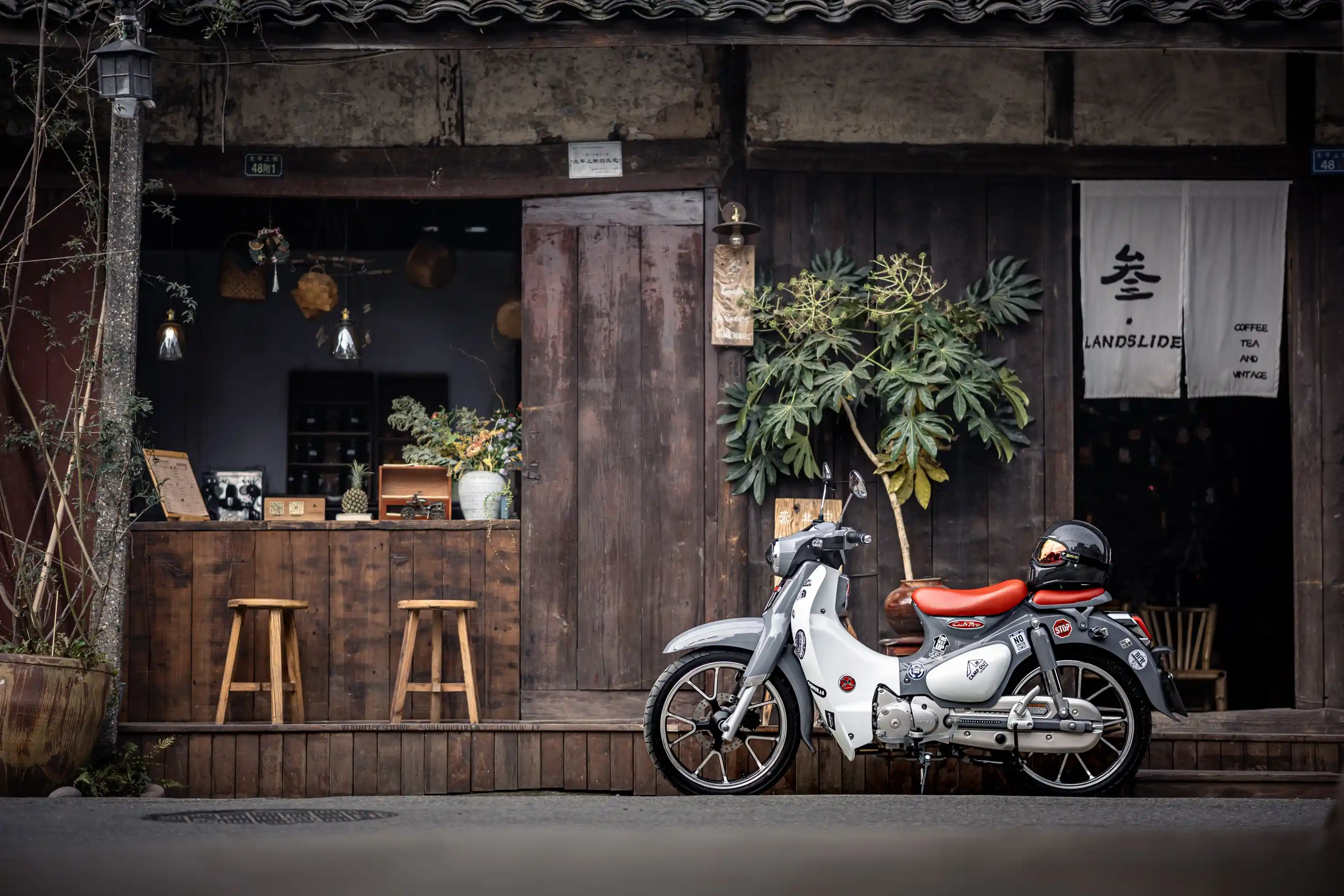
The range of Cub-style motorcycle platforms available to international distributors illustrates the variety of configurations within this product category. The local commercial position of each configuration remains dependent on market-specific pricing and retail demand.
Segment Assessment
| Segment | Observable Market Position | Main Competitive Consideration |
|---|---|---|
| Entry-level commuters | Established branded products and financing offers | Price, availability and operating costs |
| 125–150cc street motorcycles | Multiple competing retail alternatives | Product overlap and differentiation |
| Work-oriented motorcycles | Documented commercial transportation use | Maintenance, downtime and parts support |
| Cub and retro-inspired models | Potential differentiated retail positioning | Unverified segment size and sell-through |
| Recreational motorcycles | Specialized products in local retail channels | Narrower product and buyer requirements |
This table is an editorial assessment based on available market evidence, not an official ranking of motorcycle segment sales.
5. Distribution Structure and After-Sales Competition
The Dominican Republic has an established motorcycle import and distribution sector.
AFAMOTO/Analytica recorded 56 businesses in its motorcycle and related parts import category in 2023, compared with 44 in 2014.
These historical figures cover the categories defined in the study and should not be read as the current number of companies importing complete motorcycles.
The figures nevertheless indicate longstanding commercial relationships between international suppliers and domestic distributors.
Existing Dealer Networks Shape New Product Opportunities
Established importers already operate within a network of brands, retailers, financing partners and service businesses.
A new supplier may therefore be considered as part of an existing distributor’s product-range development rather than through the creation of an entirely new sales network.
New models may fill a pricing gap, replace an older product, introduce a different design or diversify sourcing.
Their commercial value depends on whether they improve the overall product range without adding disproportionate inventory and service complexity.
This is particularly relevant when multiple motorcycles share similar specifications and customer profiles.
Parts Supply Is Closely Linked to China
The AFAMOTO study reported that China accounted for approximately 89.7% of motorcycle parts and accessories imports by origin in 2023.
China’s historical concentration in parts sourcing is substantial, although it does not mean that components are interchangeable across different manufacturers or motorcycle models.
Differences in electrical systems, braking components, engine versions and bodywork can limit parts compatibility even between visually similar motorcycles.
For established distributors, product revisions and spare-parts identification influence workshop efficiency and ongoing service costs.
A broader range of models may increase the number of unique components that need to be stocked.
Where a distributor manages several generations of the same motorcycle, compatibility records and parts references become particularly relevant to replenishment.
The operational requirements of motorcycle spare-parts and after-sales programs extend beyond initial parts availability to model revisions, service documentation and recurring supply.
6. Import Economics and Distributor Margins
The commercial result of a motorcycle import program depends on how purchase costs, retail pricing and stock turnover interact.
In the Dominican Republic, the relevant cost structure includes international freight, insurance, customs charges, applicable taxes, vehicle registration and local distribution expenses.
The Dominican Customs Authority (DGA) administers customs classification and clearance.
The DGII publishes procedures for motorcycle registration.
The specific duty and tax treatment depends on the vehicle classification, the importer and the applicable transaction. Tax costs and registration expenses should not be assumed to be identical across every motorcycle shipment.
Factory Price Versus Realized Margin
Consider an illustrative procurement program in which two factory offers differ by US$40 per motorcycle.
For 1,000 motorcycles, that produces a US$40,000 difference in total FOB purchase value.
The effect on realized margin depends on what happens after the purchase.
Freight, customs valuation, financing, distributor expenses, retail discounts and warranty costs can all change the result.
If the lower-priced motorcycle has a slower sales cycle or needs greater promotional support, part of the initial saving may be absorbed before the vehicles are sold.
Inventory Holding Sensitivity
The following simplified calculation shows how financing costs can change with inventory holding time.
| Illustrative Variable | 60-Day Holding | 120-Day Holding |
|---|---|---|
| Financed inventory cost per motorcycle | US$1,000 | US$1,000 |
| Assumed annual financing rate | 18% | 18% |
| Approximate financing cost per motorcycle | US$29.59 | US$59.18 |
| Approximate financing cost for 1,000 motorcycles | US$29,589 | US$59,178 |
Illustrative calculation: financed inventory cost × annual financing rate × holding days ÷ 365. The 18% rate is a hypothetical modeling assumption, not a verified Dominican commercial lending rate. Storage, insurance, depreciation and other carrying costs are excluded.
Under these assumptions, extending the holding period from 60 to 120 days adds approximately US$29.59 in financing cost per motorcycle.
Across 1,000 motorcycles, the additional cost approaches US$30,000.
This comparison is not intended to represent actual Dominican importer profitability. It isolates one variable that can materially affect the financial benefit of a lower purchase price.
Retail Position and Turnover Are Linked
The local retail listings examined earlier show motorcycles competing within relatively defined price ranges.
A product entering one of these ranges may have limited room to raise its selling price if established alternatives are already available.
In that situation, procurement savings may improve the available margin or allow a more competitive retail price.
The benefit, however, depends on whether the product maintains sufficient sell-through.
A motorcycle that remains in inventory for several additional months may lose part of its purchase-cost advantage through financing and holding expenses.
For distributors operating established dealer networks, model-level sales performance is therefore a key component of sourcing economics.
7. Dominican Republic Motorcycle Market Outlook for 2027
The Dominican Republic enters 2027 with a substantial motorcycle population, higher recent import volumes and established competition among international suppliers.
Three developments are likely to shape the commercial outlook.
Competitive Pressure in the Commuter Segment
China’s leading historical supply position and India’s increasing import share indicate an established international competitive structure.
Public retail offers also show Indian commuter brands represented across several price positions.
This leaves additional suppliers competing with products that already have local retail visibility and financing arrangements.
The ability of new commuter motorcycles to secure lasting demand will depend on their actual competitive position rather than overall market growth.
Financing Remains an Important Retail Variable
The established presence of motorcycle financing connects retail affordability to lending terms as well as vehicle pricing.
Changes in interest rates, down-payment requirements or financing eligibility can affect the competitiveness of different motorcycles even when their advertised cash prices remain unchanged.
For products positioned close to existing retail alternatives, financing conditions may influence the outcome as much as modest differences in equipment or price.
Import Growth and Retail Absorption May Diverge
The import expansion recorded between 2023 and 2025 is clear.
What remains less transparent in national public data is the speed at which individual models are selling through local dealers.
If retail demand continues to absorb incoming motorcycles, distributors may sustain replenishment and selective product expansion.
If retail sales slow relative to imports, the consequences may include longer holding periods, discounting and greater working-capital pressure.
These are conditional developments rather than quantified forecasts.
Market Indicators for 2027
| Indicator | Commercial Relevance |
|---|---|
| Full-year 2026 motorcycle imports | Confirms whether the earlier import trend continued |
| First registrations | Adds a separate measure of vehicles entering the registration system |
| Dealer sell-through | Indicates actual customer-level demand |
| Retail prices and financing offers | Reveals changes in competitive positioning |
| Inventory turnover | Shows how efficiently distributors are absorbing supply |
| Repeat orders by model | Indicates whether demand extends beyond initial stocking |
| Parts replenishment | Provides evidence of ongoing service requirements |
The availability of these indicators will determine how confidently the 2027 market can be assessed.
National import growth establishes the scale of supply activity. Retail performance, financing and inventory data reveal more about the commercial outcome.
Conclusion: A Growing Market with More Selective Opportunities
The Dominican Republic remains an important motorcycle market, supported by substantial import activity, widespread everyday use and an established distribution network.
Its outlook for 2027 is more complex than headline growth figures suggest.
China continues to play a major role in motorcycle supply, while Indian manufacturers have gained ground in historical import data. At the retail level, financing arrangements, established brands and after-sales availability influence how motorcycles compete.
For mainstream commuter models, differentiation can be difficult in an already competitive market. Alternative product categories, including Cub-style motorcycles, may offer room for broader product positioning, although their commercial potential requires evidence from actual dealer sales and local demand.
The key issue entering 2027 is whether imported supply continues to translate into sustainable retail sales.
For importers and distributors, product-level demand, financing conditions, inventory turnover and after-sales costs will provide a clearer picture of commercial opportunities than national import growth alone.
Frequently Asked Questions
Is the Dominican Republic motorcycle market growing?
Motorcycle imports increased from 171,503 units in 2023 to 267,086 in 2025, according to DGII figures reported by Diario Libre. This demonstrates import growth, although it does not establish an equivalent increase in end-customer retail sales.
Is China the largest motorcycle supplier to the Dominican Republic?
China was the largest source in AFAMOTO’s historical import-origin analysis, accounting for 57.0% in 2023. World Bank WITS also records substantial Chinese motorcycle exports to the Dominican Republic in 2025 under HS 871120. The two datasets use different reporting definitions.
How does financing affect motorcycle sales in the Dominican Republic?
Local motorcycle financing offers include advertised down payments and monthly installments alongside vehicle prices. The resulting customer payment depends on lending terms, fees and eligibility, making financing an important part of retail competition.
Are Cub motorcycles a viable segment for Dominican distributors?
Cub-style motorcycles may offer a differentiated product position, but available national statistics do not establish the size or growth rate of the segment. Retail pricing, dealer sell-through, customer response and repeat orders provide more direct evidence of commercial demand.
What affects motorcycle distributor margins in the Dominican Republic?
Realized margins depend on landed costs, applicable import charges, local distribution expenses, retail pricing, inventory financing, stock turnover and after-sales costs. A lower factory price does not necessarily produce a higher margin if the model sells more slowly or requires additional support.
Sources and Research Methodology
Government statistics and international trade
- DGII — Vehicle Fleet Report 2025
- World Bank WITS — 2025 Motorcycle Exports to the Dominican Republic, HS 871120
- Dominican Customs Authority (DGA)
- DGII — Motorcycle Registration Information
Industry and retail research
- AFAMOTO / Analytica — Motorcycle Commercialization Sector Study, January 2025
- Diario Libre — Motorcycle Import Trends, May 21, 2026
- Kompii — Dominican Motorcycle Retail and Financing Catalog
Research notes
Research cut-off: November 17, 2026.
DGII import statistics, first registrations, registered-fleet totals and World Bank WITS export records are different statistical measures and should not be combined without reconciling their definitions.
Historical import-origin shares refer to the years stated and are not represented as current 2026 market shares. Retail financing figures are publicly advertised examples rather than confirmed transaction records.
The inventory-financing calculation is illustrative and does not represent actual distributor costs, KAMAX quotations or a market-wide profitability estimate.
No national 2027 motorcycle sales forecast or unverified segment market-share estimate is asserted.