
About the Article
A motorcycle model may already hold EU type approval, but that does not remove the need to verify the configuration supplied in subsequent production batches.
Between orders, component suppliers may change, technical revisions may be introduced, or manufacturing arrangements may be updated. The commercial model name can remain the same while the underlying production configuration changes.
For European motorcycle importers, the relevant questions are whether the new batch remains covered by the applicable vehicle approval, whether production conformity arrangements remain appropriate, and whether any changes require further review.
Quick Answer: What Should Importers Check Before a Repeat Motorcycle Order?
Conformity of Production (CoP) is the system of manufacturing controls, verification and regulatory oversight intended to ensure that vehicles produced in series continue to conform to their approved type.
For repeat orders, importers should focus on three areas:
- Approval and configuration: Does the proposed motorcycle match the applicable EU type approval, including its type, variant and version?
- Changes since the previous order: Have any regulated components, technical specifications or relevant production arrangements changed?
- Conformity documentation: Are the applicable manufacturer assessment, vehicle identification and Certificate of Conformity (CoC) arrangements still appropriate?
A repeat order does not automatically require a newly issued CoP assessment document. The manufacturer must maintain the required production conformity arrangements, while the importer must meet its own obligations before placing vehicles on the EU market.
Additional production evidence may be reviewed according to identified risks and the agreed procurement arrangements.
The principal legal references are Regulation (EU) No 168/2013, particularly Articles 9, 12, 16 and 33, and Regulation (EU) No 44/2014, Article 8 and Annex IV.
1. Understand the Different Responsibilities Under EU CoP
EU type approval establishes the approved vehicle type and relevant technical configuration.
Conformity of Production concerns the continuing manufacturing arrangements used to ensure that production vehicles conform to that approval.
The Certificate of Conformity connects an individual vehicle to its approved type.
These requirements involve different responsibilities.
Manufacturer and Type-Approval Holder
Under Regulation (EU) No 168/2013, Article 9, manufacturers are responsible for ensuring that series production continues to conform to the approved type.
This includes maintaining the necessary production procedures and accounting for relevant design or regulatory changes.
The type-approval holder also has responsibilities under the applicable CoP arrangements, including those described in Annex IV to Regulation (EU) No 44/2014.
Approval Authority
Under Article 33 of Regulation (EU) No 168/2013, the approval authority granting the approval must verify that adequate arrangements exist to maintain production conformity.
The authority also has responsibilities for continued verification under the applicable regulatory framework.
A manufacturer’s internal production records and an approval authority’s assessment are therefore related, but they serve different functions.
EU Importer
Article 12 establishes separate obligations for importers.
Among these, an importer must verify that a type-approved vehicle is accompanied by the required CoC before placing it on the market.
Where the importer has reason to believe that a vehicle does not conform to the applicable requirements or its type approval, it must not place the affected vehicle on the market until conformity has been established.
This does not create a general requirement for importers to perform a new CoP audit before every purchase order.
An importer may, however, request appropriate confirmation of continued approval applicability, technical changes and relevant production-conformity information as part of its purchasing arrangements.
An Important Distinction for Private-Label Importers
Under Article 16, an importer or distributor may be treated as a manufacturer for regulatory purposes when placing a vehicle on the market under its own name or trademark, or when making modifications that may affect compliance.
For customer-owned-brand motorcycle projects, the legal manufacturer’s identity, approval responsibilities, branding and production arrangements therefore need to be established for the specific project.
A private-label purchasing agreement alone should not be assumed to settle these regulatory responsibilities.
For a broader explanation of European approval terminology, see EEC Type Approval vs Euro 5+ vs CoC.
2. Start Repeat Order Verification With What Has Changed
An importer purchasing the same approved motorcycle again does not necessarily need to repeat every assessment completed for the original order.
The first step is to identify whether the proposed production configuration and relevant conformity arrangements remain unchanged.
Three Levels of Repeat Order Verification
| Review Level | What to Confirm | When It Applies |
|---|---|---|
| Baseline Verification | Applicable EU type approval, type/variant/version, proposed production specification and CoC arrangements | Every repeat-order review |
| Change Verification | Engine, ECU, exhaust, braking, lighting, other approval-sensitive components and relevant manufacturing changes | When specifications, components, suppliers or production arrangements have changed |
| Risk-Triggered Review | Additional technical evidence, conformity records, validation results or approval clarification | When changes, discrepancies, quality issues or assessment-scope concerns remain unresolved |
This is a suggested importer procurement framework, not a statutory requirement to conduct three separate audits for every order.
Baseline Verification
For an unchanged configuration, the procurement review should establish that the new order still corresponds to the applicable approved type, variant and version.
The current vehicle specification should be identifiable, and the manufacturer should confirm the relevant vehicle identification and CoC arrangements.
The commercial model name alone is insufficient if several technical variants are available.
Change Verification
A change since the previous order does not automatically mean that the motorcycle has lost its approval.
The relevant question is whether the revised configuration remains within the existing approval scope or requires further assessment, documentation or approval action.
Changes may involve:
- Engine or fuel-management components.
- ECU hardware, software or calibration.
- Exhaust and emissions-control equipment.
- Braking, lighting or other regulated systems.
- Approved wheel or tyre specifications.
- Relevant manufacturing arrangements or supplier substitutions.
Not every supplier change affects type approval. Its significance depends on the approved configuration and the component involved.
Risk-Triggered Review
Additional evidence becomes more relevant when the information supplied does not establish continued conformity.
For example, a new ECU revision with unresolved emissions or diagnostic implications may justify further technical and approval review.
A significant production-quality issue may justify examining relevant conformity controls and corrective actions.
A change in the legal manufacturing entity or production location may require confirmation of how the existing approval and manufacturer-assessment arrangements apply.
The additional review should address the identified issue rather than automatically requesting every internal manufacturing document.
3. Production Controls Must Support the Approved Configuration
Conformity of Production relies on the manufacturer’s ability to keep the vehicles produced in series consistent with their approved type.
Regulation (EU) No 44/2014, Annex IV, addresses initial assessment, product conformity arrangements and continued verification.
Relevant production controls may include:
Approved Technical References
The applicable vehicle specification, component configuration and controlled production revisions.
Component and Supplier Controls
Verification of relevant purchased components, approved specifications and component changes.
Manufacturing and Inspection Controls
Production processes, applicable checks and tests, together with records required under the relevant conformity arrangements.
Change Control
Engineering review, necessary authorization and controlled implementation of changes affecting the approved production configuration.
Production Traceability
Records connecting the applicable configuration to the affected orders, batches or vehicles.
The precise records, test frequencies and verification methods depend on the regulatory requirements and the manufacturer’s applicable control arrangements.
A general ISO 9001 certificate, routine factory inspection or satisfactory pre-shipment inspection is not, by itself, proof that every production configuration remains covered by the applicable EU type approval.
Example: An ECU Supplier Change
Consider an approved motorcycle whose manufacturer proposes a new ECU supplier for a subsequent production batch.
The replacement ECU may offer similar functions and physical connections, but this does not establish that the revised system remains equivalent under the vehicle’s approval.
Engineering and compliance review may need to assess:
- Hardware and electrical compatibility.
- Software and calibration.
- Emissions-control operation.
- Applicable on-board diagnostics requirements.
- The effect on the approved vehicle configuration.
- Whether additional validation or approval action is required.
This is an illustrative scenario, not a reported KAMAX engineering-change incident.
If the revised component is accepted, the applicable production records should identify where the new configuration takes effect.
That information may also be relevant when ordering replacement parts for earlier production batches.
4. Resolve Approval Discrepancies Before Market Release
A repeat order can present different compliance situations.
Situation 1: No Identified Configuration Change
The quoted motorcycle remains aligned with the applicable approval, and the relevant CoC and conformity arrangements are confirmed.
The importer can proceed through its normal purchasing checks without treating the order as an entirely new type-approval project.
Situation 2: A Change Has Been Properly Reviewed
The manufacturer identifies a revised component and confirms the relevant engineering review and approval applicability.
The importer can assess the revised specification and obtain the agreed supporting information before confirming the affected configuration.
Situation 3: Approval Applicability Is Unresolved
The quoted motorcycle includes an approval-sensitive change, but the available information does not establish whether the existing approval covers it.
The affected configuration requires clarification by the responsible manufacturer, approval holder and relevant technical or regulatory parties.
Commercial shipment acceptance cannot replace that determination.
Under Article 12 of Regulation (EU) No 168/2013, an importer with reason to believe a vehicle does not conform to the applicable requirements must not place it on the EU market until the issue has been resolved.
What Information Can an Importer Reasonably Request?
Depending on the project, a focused review may use:
- Applicable EU type-approval information and the relevant vehicle configuration.
- Confirmation of the manufacturer and approval holder.
- Relevant CoP or manufacturer-assessment information within its authorized scope.
- Confirmation of technical changes since the previous order.
- Appropriate summaries of conformity verification or change approvals, where available.
- Confirmation of vehicle identification and CoC arrangements.
Detailed supplier records, internal control plans and audit documentation may be confidential or accessible only to authorized parties.
The objective is to establish whether the intended vehicles remain compliant, not to transfer the manufacturer’s entire quality-management system to the buyer.
5. KAMAX’s Published CoP and Manufacturer Assessment Evidence
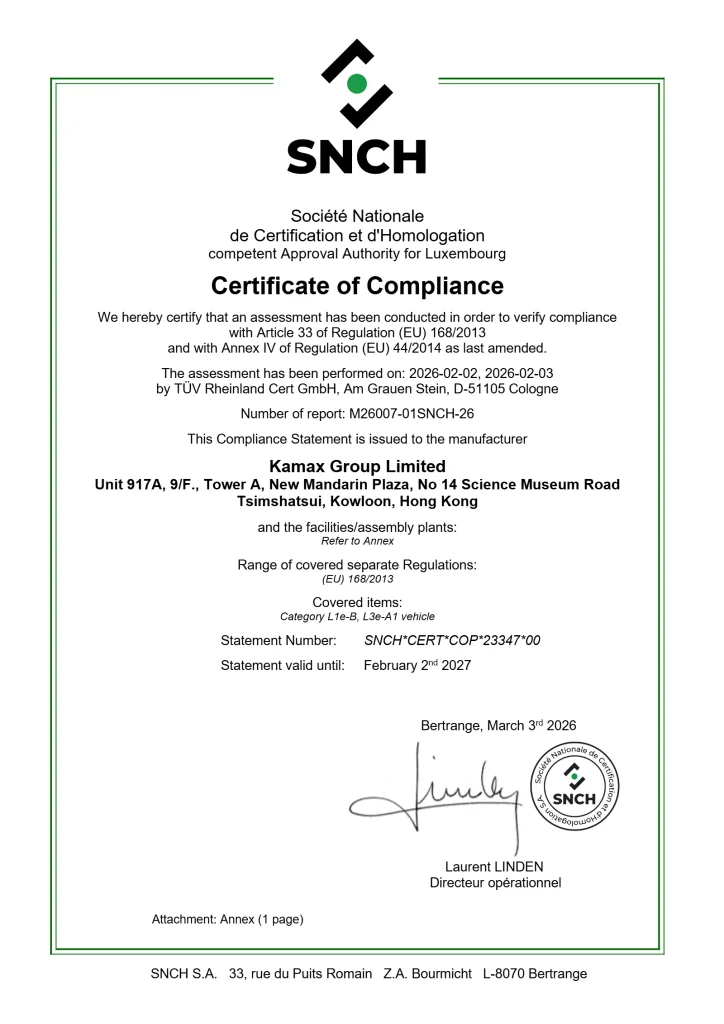
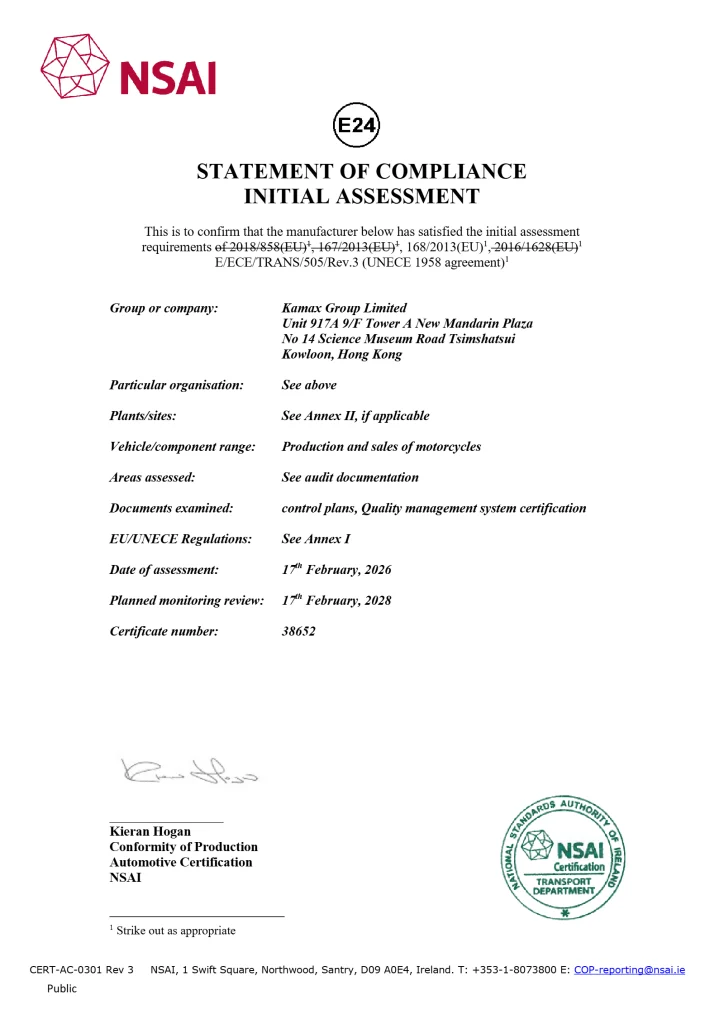
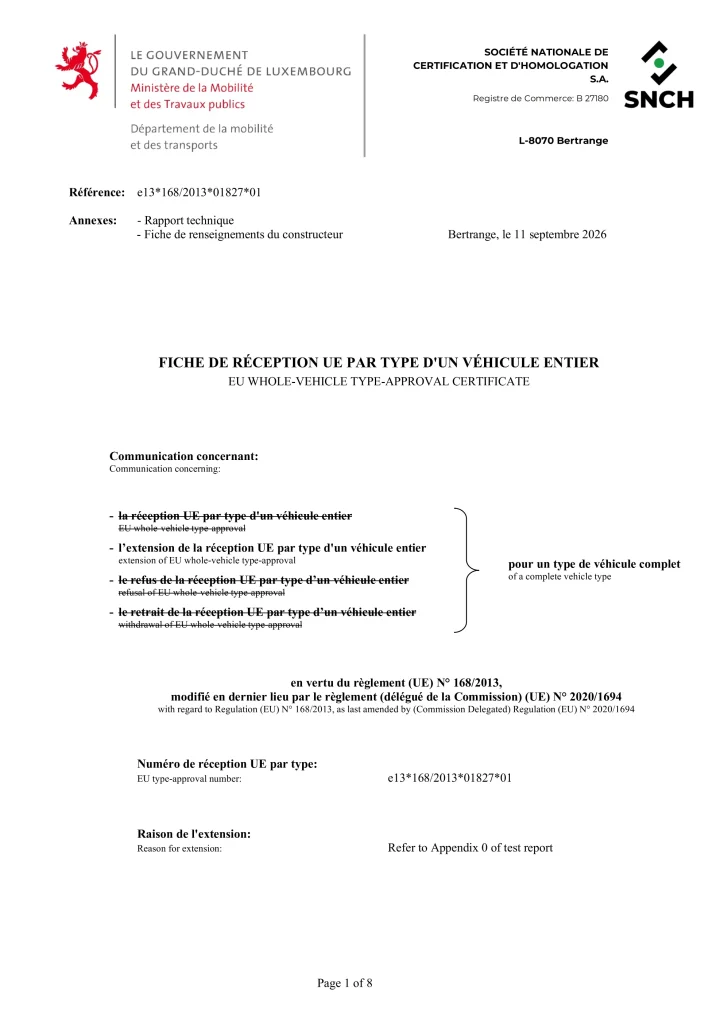
KAMAX publicly presents manufacturer-assessment documentation and selected EU whole-vehicle type approvals on its Homologation & Compliance page.
These records provide different kinds of evidence and should not be treated as interchangeable approvals.
Published Compliance Documentation
| Document | Published Information | What It Establishes |
|---|---|---|
| SNCH — Conformity of Production | CoP assessment conducted by TÜV Rheinland under Regulations (EU) No 168/2013 and No 44/2014; published scope references L1e-B and L3e-A1; issued by SNCH, Luxembourg, February 2026 | Evidence of manufacturer production-conformity assessment within the documented scope |
| NSAI — Manufacturer Initial Assessment | KAMAX Group Limited; NSAI, Ireland; February 2026; review of manufacturing control plans and quality-management documentation | Evidence of manufacturer initial-assessment arrangements within the applicable documented scope |
| Cub Pro 125 — EU Whole-Vehicle Type Approval | Euro 5+; L3e-A1; SNCH, Luxembourg; approval e13*168/2013*01827*01; latest published extension September 2026 | A vehicle-specific approval reference that must be matched to the applicable type, variant, version and configuration |
Source: KAMAX Motorcycle Homologation & Compliance Support.
What These Documents Do—and Do Not—Establish
The SNCH CoP information and NSAI initial-assessment information concern manufacturer assessment and production control within their respective documented scopes.
The Cub Pro 125 approval concerns a defined vehicle type and applicable approved configurations.
They are not interchangeable.
For a particular import order, the relevant assessment information should be checked against the legal entity, manufacturing activities, applicable production facilities and vehicle categories recorded in the underlying documents.
The type-approval information must also be matched to the exact vehicle type, variant, version and technical specification being purchased.
A manufacturer assessment issued in February 2026 does not, by its date alone, prove that every later production batch or configuration has been separately verified.
Likewise, the Cub Pro 125 approval does not automatically extend to other KAMAX models or customer-modified configurations.
How KAMAX Supports Project Verification
KAMAX provides model-specific technical specifications, available approval information and engineering-documentation support for applicable European motorcycle projects.
This may include reviewing an existing approved configuration, assessing proposed OEM modifications and coordinating relevant technical or certification requirements.
The documentation and review scope depend on the model, approval status, intended market and project agreement.
Importers can discuss the proposed motorcycle configuration with KAMAX before finalizing the purchasing specification, particularly where additional equipment, private-label branding or technical modifications are involved.
6. CoP and Pre-Shipment Inspection Serve Different Purposes
Conformity of Production addresses continued compliance with the approved vehicle type through the manufacturer’s production arrangements.
Factory quality control addresses applicable manufacturing and product requirements.
Pre-Shipment Inspection (PSI) assesses an identified commercial shipment against its agreed inspection criteria.
These activities are related but do not replace one another.
A shipment may pass visual, functional and packing checks while a proposed technical change still requires approval clarification.
Likewise, appropriate CoP arrangements do not eliminate the need to check shipment condition, quantity or other agreed delivery requirements.
For the separate roles of factory inspection and vehicle preparation, see Motorcycle PSI vs PDI: Importer Inspection Guide.
Frequently Asked Questions
Does a motorcycle importer need a new CoP document for every repeat order?
Not automatically. EU CoP requirements concern continuing production conformity arrangements, rather than the routine issue of a new manufacturer CoP assessment document for every purchase order. The importer must still ensure the vehicles meet applicable requirements, including the relevant approval and required CoC documentation before placing them on the market.
Is CoP the same as EU motorcycle type approval?
No. EU type approval establishes the approved vehicle type and relevant configurations. CoP concerns the manufacturing arrangements and continued verification used to maintain conformity with that approved type.
Can a manufacturer change a motorcycle component after type approval?
Yes, subject to the applicable technical and regulatory requirements. The change must be assessed to determine whether the revised configuration remains within the existing approval or requires additional testing, documentation or approval action.
Do private-label motorcycle importers have manufacturer responsibilities in the EU?
They can. Under Article 16 of Regulation (EU) No 168/2013, an importer or distributor placing a vehicle on the market under its own name or trademark, or making compliance-affecting modifications, may be subject to the manufacturer’s obligations under the regulation. The applicable legal and approval responsibilities should be clarified for the project.
Planning a Repeat Motorcycle Order for Europe?
Share your target market, motorcycle model, proposed technical configuration and purchasing requirements with KAMAX.
Our engineering and export teams can review available model-specific approval information, discuss relevant configuration changes and confirm the technical-documentation support available for your project.