About the Article
A replacement part ordered for a familiar motorcycle model may not fit every vehicle sold under that name.
During a model’s production life, manufacturers may revise electrical connectors, engine components, mounting arrangements or other parts. Different markets and OEM customers may also receive different specifications. These differences are not always visible from the motorcycle’s appearance or commercial model name.
For distributors managing several production batches, the purchasing challenge is identifying which component belongs to which vehicle configuration—and whether a newer part can replace an earlier version.
Accurate ordering depends on the vehicle’s technical identity, the original component reference and confirmed compatibility information.
Quick Answer: How Do Distributors Verify Motorcycle Spare Parts Compatibility?
Motorcycle spare parts compatibility should be verified against the applicable vehicle configuration, original part reference and manufacturer-confirmed replacement information—not the model name alone.
A practical verification process follows four steps:
- Identify the vehicle: Confirm the model, technical variant and available production reference.
- Identify the original part: Check the installed component number, applicable parts list or other technical references.
- Verify the replacement: Establish whether the proposed component is an exact match, an approved substitute or a replacement requiring additional parts.
- Confirm the order: Record the applicable vehicle range and technical confirmation before approving the part and quantity.
Depending on the motorcycle, supporting information may include a VIN, engine number, production batch, exploded parts diagram or Electronic Parts Catalog (EPC).
A VIN can support configuration identification when corresponding manufacturer records are available. It does not independently reveal every component revision.
1. Why Motorcycle Parts Differ Across Model Revisions
Three types of variation are particularly relevant to distributor parts orders.
Production Revisions Within the Same Model
A motorcycle may retain its model name while individual components are revised during production.
For example, a later production batch may use a modified wiring connector, revised mounting bracket or replacement electrical assembly.
The change may improve manufacturing consistency, resolve a technical issue or reflect a supplier substitution.
The relevant parts information must establish which configuration uses the earlier component and which uses the revised one.
A model year is not always sufficient to make this distinction. Changes may occur during the same year, while different configurations may be produced at overlapping times.
Different Market Specifications
Motorcycles within the same family may have different engines, fuel systems, braking equipment, lighting or emissions-related components for different markets.
An electrical assembly supplied for one approved market configuration should not be assumed to fit another.
The applicable destination-market specification therefore remains part of the parts-identification process.
OEM and Private-Label Configurations
Customer-owned-brand motorcycles may share a platform with standard KAMAX models while using customized instruments, body panels, wiring or other components.
Replacement parts for these motorcycles need to be matched to the approved OEM project configuration.
The platform name, engine displacement or external appearance may help identify the motorcycle family, but they do not establish every component reference.
2. Identify the Correct Vehicle and Original Part
Before selecting a replacement component, the distributor needs enough information to distinguish the affected motorcycle from other versions.
Confirm the Vehicle Configuration
The most useful identifiers depend on the part being ordered.
| Vehicle Reference | When It Helps |
|---|---|
| Model and Variant | Identifies the motorcycle family and applicable configuration |
| Engine Model or Number | Helps distinguish engine and powertrain components |
| VIN or Frame Number | Supports vehicle identification and configuration lookup where corresponding records exist |
| Production Batch or Revision | Helps identify changes introduced during manufacturing |
| Market or OEM Project | Distinguishes destination-specific and customer-specific equipment |
| Installed Component Marking | Helps verify the original component or assembly |
For example, an engine number may be especially useful when identifying internal engine parts. A wiring harness may instead require the applicable electrical configuration, connector details and production-revision information.
Not every identifier is necessary for every order. The required evidence should match the component and the variation being investigated.
Match the Original Component Reference
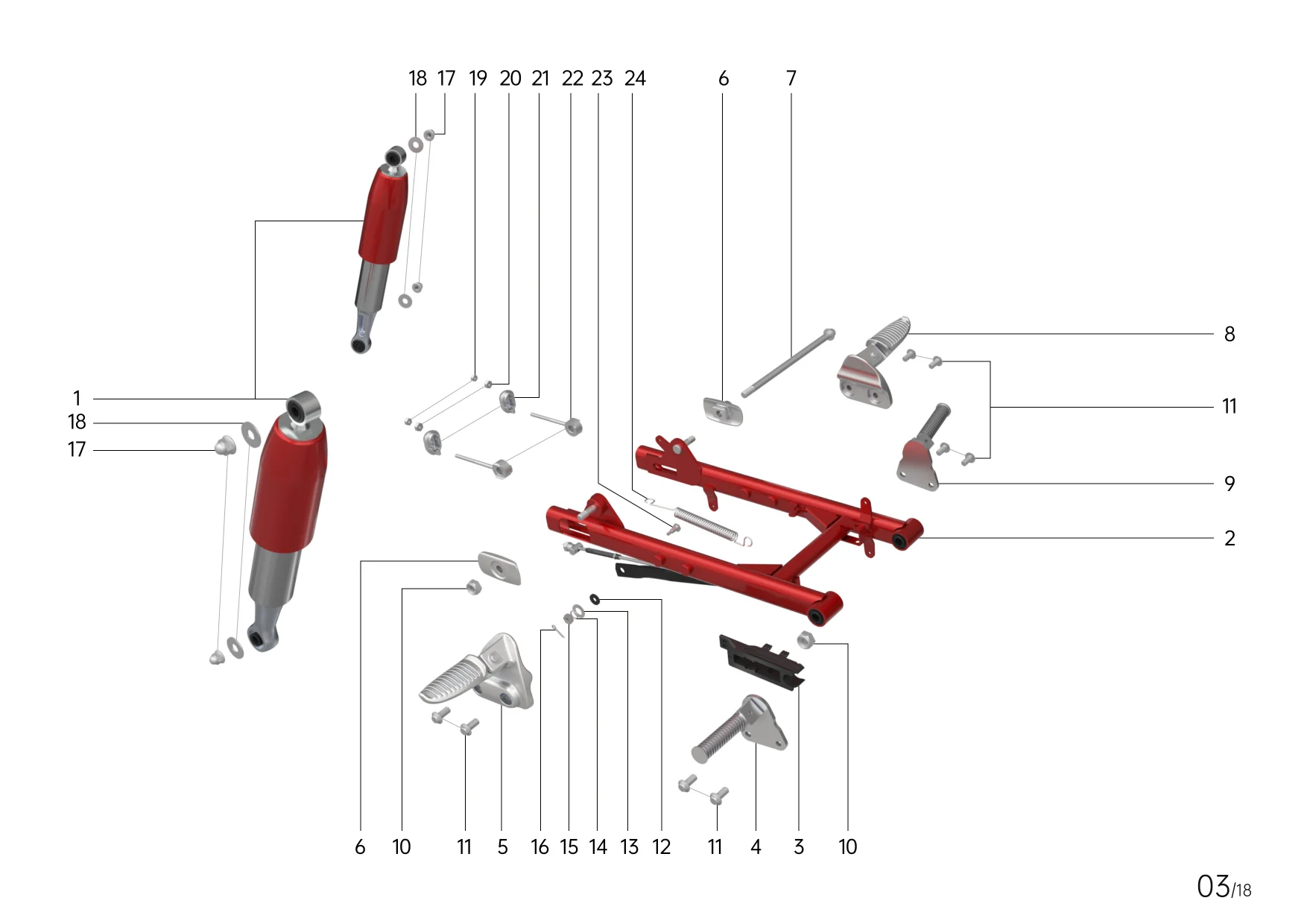
Where available, model-specific parts lists, exploded diagrams and EPC records can help identify the correct component number and its position within an assembly.
The relevant catalogue revision matters.
An older diagram may reference a part that was subsequently replaced, while a newer catalogue may identify a different component for a revised motorcycle configuration.
An original part number provides a useful starting point, but it should still be checked against the intended vehicle application.
When the Part Number Is Missing
A local dealer may report a failed component without providing its part number.
The distributor can collect the motorcycle identification, installed-component photographs, visible markings, connector details, mounting arrangement and available service records.
These references can then be submitted for technical review against the applicable motorcycle configuration.
If the available information cannot establish compatibility, the proposed order line should remain unconfirmed.
This is particularly important for safety-related components and electrical equipment whose external appearance may not reveal relevant technical differences.
3. Verify Part Supersession and Interchangeability
A new component reference does not automatically mean that the revised part can replace every earlier version.
Manufacturers may revise part numbers because of design changes, supplier substitutions or component updates.
Some revised parts are directly interchangeable. Others require additional components or are only suitable for certain production ranges.
Motorcycle Parts Compatibility Decision Matrix
| Compatibility Status | Meaning | Ordering Decision |
|---|---|---|
| Verified Exact Match | The identified part matches the confirmed vehicle configuration | Proceed with the specified component |
| Approved Direct Replacement | The manufacturer confirms that the replacement is suitable for the stated application without additional changes | Order the approved replacement |
| Approved Replacement with Additional Requirements | The replacement requires specified related parts, installation procedures or other conditions | Confirm the complete replacement arrangement |
| Compatibility Unverified | Available information is insufficient to establish suitability | Hold the affected order line for technical verification |
| Confirmed Incompatible | The proposed component is unsuitable for the intended configuration | Reject the proposed part and identify a suitable alternative |
This matrix is an illustrative distributor purchasing framework, not a reproduction of KAMAX’s internal parts-classification system.
A Superseded Part Number Is Not Always a Direct Replacement
Part supersession means that a newer reference has replaced an earlier one in the applicable parts information.
It does not always mean unrestricted interchangeability.
For instance, a revised electrical assembly might require a matching connector or harness component. A modified mechanical component might require different mounting hardware.
Compatibility can also be directional.
A newly approved component may replace an earlier version, while the old component may not be approved for use in vehicles manufactured to the revised specification.
Distributors should therefore verify:
- The original and replacement part references.
- The vehicle configurations or production ranges covered.
- Whether direct interchangeability has been confirmed.
- Whether additional components or installation requirements apply.
- The source of the compatibility confirmation.
A supplier’s statement that two components look or function similarly is not a substitute for the applicable technical confirmation.
When Can Parts Be Shared Across Models?
Common-platform components can simplify inventory management, but shared stock should be based on confirmed compatibility.
Two motorcycles may use the same engine family while having different electrical or mounting arrangements.
Likewise, parts with similar dimensions may differ in material specification, calibration or approved application.
A distributor should treat parts as common stock only when the corresponding model and configuration coverage has been established.
4. Practical Example: A Headlamp Revision Between Production Batches
Consider a distributor that has imported two production batches of the same 125cc underbone motorcycle.
The later batch uses a revised headlamp assembly with a different electrical connector.
The motorcycles have the same commercial model name, and the headlamp units appear similar from the outside.
A dealer servicing a motorcycle from the earlier batch requests a replacement headlamp, but the older component reference is no longer shown in the distributor’s latest purchasing list.
Step 1 — Identify the Affected Motorcycle
The distributor confirms the relevant vehicle identification and, where available, its production batch or approved configuration revision.
This establishes whether the motorcycle belongs to the earlier or later electrical configuration.
Step 2 — Confirm the Installed Component
The dealer provides the original headlamp reference, connector photographs and any other relevant identifying information.
The distributor compares these details with the applicable parts records.
Step 3 — Check the Proposed Replacement
The later headlamp assembly cannot be treated as a direct replacement merely because it fits the same body opening.
The technical review must establish whether:
- The revised lamp is approved for the earlier motorcycle configuration.
- Its electrical connector and other relevant specifications are compatible.
- A manufacturer-approved adapter, harness component or replacement kit is necessary.
- Any applicable lighting approval or other regulatory requirement is affected.
Step 4 — Confirm the Correct Supply Arrangement
The result may be an available earlier-version headlamp, an approved direct replacement or a revised assembly supplied with the necessary related components.
If no suitable replacement has been confirmed, the distributor should not approve the proposed substitution.
The order should identify the approved component or complete replacement arrangement together with its applicable vehicle range.
This example is hypothetical and does not describe an actual KAMAX component revision or compatibility incident.
It illustrates the distinction between identifying a newer part number and confirming that the part is suitable for an earlier production version.
5. Build a Distributor Parts Order With Verifiable References
In a distributor network, parts requests often arrive from different dealerships using local descriptions, older catalogue references or photographs.
When these requests are consolidated, the purchasing team needs to preserve the information that identifies each vehicle and supports the chosen component.
A parts order should not contain only a model name, part description and quantity when compatibility depends on a specific revision.
Distributor Parts Identification & Order Record
| Order Field | Information to Record |
|---|---|
| Vehicle Identification | Brand, model, variant or relevant OEM project code |
| Technical Configuration | Engine, braking, electrical or other specifications affecting the requested part |
| Applicable Production Reference | Production batch, configuration revision, serial range or available identifying record |
| Original Component | Installed part number, description or relevant catalogue reference |
| Proposed Supply Part | Current part number, approved substitute or complete replacement kit |
| Compatibility Decision | Exact match, approved replacement, conditional replacement, pending verification or incompatible |
| Confirmation Basis | Applicable catalogue revision, engineering record or authorized technical confirmation, including date where relevant |
| Order Quantity | Confirmed quantity and unit of measure for the applicable vehicle population |
This is an illustrative ordering template. The available identification and confirmation records vary by model and project.
Separate Confirmed and Unverified Order Lines
A consolidated order may contain routine service parts with confirmed references alongside components requiring further review.
Unverified items should not be presented as approved replacements.
Where the order process allows, the distributor can retain confirmed lines for purchasing while holding the affected lines for technical clarification.
If the revision affects a complete kit or related components, the purchasing team should confirm the full supply requirement rather than ordering only the visually similar replacement part.
Retain Compatibility Information for Future Orders
Once a replacement has been confirmed, the distributor should retain the original reference, approved replacement, applicable vehicle range and any installation restrictions.
This is especially useful when the original part number is no longer supplied.
If a distributor uses its own warehouse stock codes, those codes should remain linked to the relevant manufacturer references and confirmed applications.
Additional Considerations for OEM, SKD and CKD Programs
For customer-owned-brand motorcycles, the approved project configuration should be included in the parts-identification record.
For SKD and CKD programs, component references may also be linked to packing lists, assembly documentation and local production records.
Where a local assembly partner introduces an authorized configuration change, the resulting spare-parts requirements need to reflect that change.
See KAMAX CBU, SKD & CKD Motorcycle Supply for the broader component-supply and assembly arrangements.
6. How KAMAX Supports Parts Identification Across Different Versions
KAMAX coordinates replacement-parts supply and technical assistance for international distributors, OEM partners and local assembly programs.
Parts identification is reviewed against the applicable motorcycle model, project specification, component references and available production information.
The required review depends on the information supplied and the status of the requested part.
When the Original Part Is Identified
If the distributor provides a confirmed component number and the relevant vehicle configuration, KAMAX can review the applicable parts information and component availability.
The order quantity, supply arrangement and delivery schedule are confirmed according to the component and project requirements.
When the Original Part Number Has Been Replaced
If a previously supplied part has been revised or superseded, the available technical references can be reviewed to determine the suitable replacement for the intended configuration.
Where a newer component is not directly interchangeable, related parts or technical requirements may need to be confirmed.
The replacement should not be treated as approved for every vehicle in the model family without appropriate application information.
When the Component Reference Is Unclear
A distributor may have the vehicle model and photographs but no reliable original part number.
Depending on the motorcycle, identification may be supported by model-specific parts lists, exploded diagrams, EPC records where available, engine information, VIN or relevant production references.
KAMAX’s export and technical personnel can coordinate further review using the available documentation and project information.
These resources do not have identical coverage for every model or production period. Where compatibility cannot be confirmed from the available evidence, additional technical clarification may be required before the part is ordered.
Parts Availability and Ongoing Supply
Availability is assessed for the relevant component, motorcycle model and supply arrangement.
For selected established models and platforms, KAMAX supports long-term spare-parts supply under applicable project terms. This does not imply permanent availability of every original component or an unrestricted replacement option.
More information is available on KAMAX Motorcycle Spare Parts & After-Sales Support.
For initial stock quantities and launch preparation, see First Shipment Motorcycle Spare Parts Package for Distributors.
Frequently Asked Questions
Can two motorcycles with the same model name use different spare parts?
Yes. Production revisions, destination-market specifications and OEM configurations may introduce different engines, electrical components, braking equipment or other parts without changing the commercial model name. Compatibility should be confirmed against the relevant vehicle configuration.
Is a motorcycle VIN enough to identify the correct replacement part?
Not always. A VIN may support configuration identification where suitable manufacturer records are available. Depending on the component, the engine number, production revision or original part reference may also be required.
Can a newer motorcycle part number replace an older one?
Only where the applicable replacement has been technically confirmed. Some revised parts are directly interchangeable, while others require additional components or apply only to certain production versions. Replacement compatibility should not be assumed to work in both directions.
What if the original motorcycle part number is unavailable?
The distributor should provide the model, relevant vehicle or engine information, installed-component photographs, visible markings and any available production references. The manufacturer can review the available technical information to help identify the correct component or approved replacement. Unverified substitutions should not be treated as confirmed orders.
Discuss Your Motorcycle Spare Parts Requirements
KAMAX works with motorcycle distributors, importers and OEM partners on model-specific spare-parts supply and technical coordination.
Share your motorcycle models, vehicle or engine identification where available, original part references, component photographs and required quantities.
Our export and technical teams can review the available parts information, compatibility requirements and relevant supply arrangements.