About the Article
The KAMAX Cub family began with a single vehicle platform. Today, it includes eight models, ranging from everyday commuter motorcycles and European-approved urban models to factory-custom designs, outdoor motorcycles and electric mobility.
Each model has taken the original platform in a different direction. Some retain much of its established architecture, while others involve changes in bodywork, vehicle design, equipment, functionality or propulsion.
The result is a motorcycle family with a common engineering origin but distinct commercial applications.
For KAMAX, platform development is an ongoing process. An established motorcycle provides the foundation for further development, whether the requirement is a new product direction, an upgraded specification or a customer-specific model.
Quick Answer
Motorcycle platform development uses an established vehicle architecture as the foundation for multiple models with different designs, powertrains, equipment and applications.
At KAMAX, the CUB K110, K125, Pro 50, Pro 125, Cub S, Cub X, Cub Cross and Cub EV originate from the same Cub development platform.
The platform supports conventional and electric propulsion, different braking and engine management configurations, and applications ranging from daily transportation to outdoor riding. Further specifications can be developed according to customer requirements, engineering feasibility and destination-market regulations.
The KAMAX Cub Platform: One Foundation, Multiple Product Directions
Our Cub motorcycle range has evolved through a combination of specification development, vehicle design changes, functional adaptation and powertrain development.
The eight models represent six distinct product directions.
| Model | Product Direction | Platform Development Focus |
|---|---|---|
| CUB K110 | Everyday mobility | Practical equipment and 110cc powertrain configuration |
| CUB K125 | Everyday mobility | 125cc powertrain and market-specific specifications |
| CUB Pro 50 | Premium compact mobility | Small-displacement urban mobility and European compliance |
| CUB Pro 125 | Premium urban mobility | Advanced equipment, electronic systems and Euro 5+ development |
| CUB S | Custom lifestyle | Distinctive bodywork, retro styling and chassis equipment |
| CUB X | Urban adventure | Ground clearance, outdoor riding and road-surface adaptability |
| CUB Cross | Outdoor mobility | Functional design and outdoor-oriented applications |
| CUB EV | Electric mobility | Electric propulsion and adaptation of the original vehicle concept |
The common platform does not mean that all eight motorcycles use identical frames, body panels or mechanical components. The degree of engineering reuse varies according to the requirements of each model.
What connects them is their development origin and the continued evolution of the Cub architecture.
Different Engineering Solutions Within One Platform
The technical differences between the CUB K110 and Pro 125 offer a practical example of how a shared platform can support different vehicle specifications.
Both models have a declared wheelbase of 1,245 mm. Their documented powertrain, fuel delivery and braking configurations, however, reflect different product requirements.
The tested K110 specification uses a 107cc four-stroke engine with carburettor fuel delivery and CDI ignition. The Pro 125 combines a 125cc-class engine with electronic fuel injection (EFI) and ECU-based engine management.
Their braking systems also illustrate the flexibility of the platform.
The K110 has undergone TÜV Rheinland testing with front-wheel ABS and combined braking system (CBS) configurations. The Pro 125 programme additionally covers dual-channel ABS operating on both wheels.
| Technical Feature | CUB K110 | CUB Pro 125 |
|---|---|---|
| Development platform | KAMAX Cub | KAMAX Cub |
| Displacement class | 110cc | 125cc |
| Engine type | Single-cylinder, four-stroke | Single-cylinder, four-stroke |
| Fuel delivery | Carburettor | Electronic fuel injection |
| Engine control | CDI ignition | ECU-based engine management |
| Maximum net power | 4.7 kW at 8,000 rpm | 6.3 kW at 7,500 rpm |
| Maximum net torque | 7.2 Nm at 5,500 rpm | 9.6 Nm at 4,000 rpm |
| Transmission | Four-speed | Four-speed |
| Wheelbase | 1,245 mm | 1,245 mm |
| Front-wheel ABS | TÜV-tested configuration | Type-approved configuration |
| Dual-channel ABS | Not covered by the referenced test report | Type-approved configuration |
| CBS | TÜV-tested configuration | Type-approved configuration |
| Regulatory documentation | TÜV Rheinland test report under Directive 2002/24/EC | EU whole-vehicle type approval under Regulation (EU) No 168/2013, Euro 5+ |
Technical data refers to specific documented vehicle configurations. Equipment availability may vary according to the selected specification and destination market.
The K110 and Pro 125 demonstrate one form of platform development: retaining an established vehicle architecture while integrating different powertrain, electronic and braking solutions.
The K125 and Pro 125 also illustrate how two motorcycles within the same displacement class can occupy different retail positions. The distinction between them is not simply engine capacity, but the overall specification, product identity and intended market.
Extending the Platform Beyond Everyday Transportation
Specification development is only one part of the Cub programme.
With the Cub S, Cub X and Cub Cross, we have extended the original platform through changes in vehicle design, bodywork, equipment and riding application.
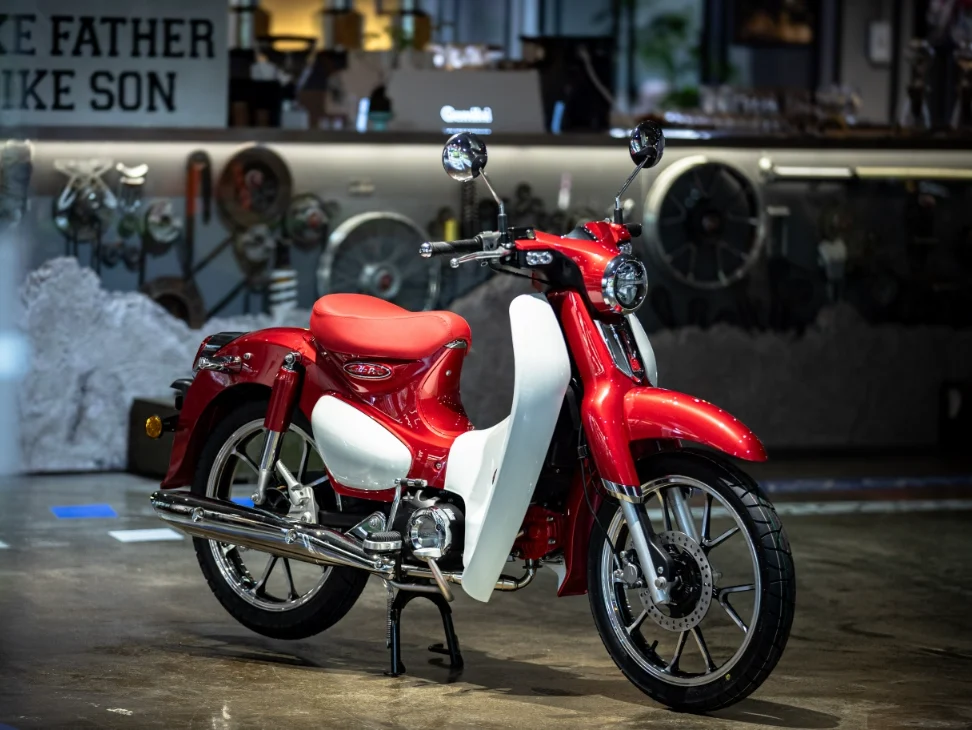
The Cub S takes the platform towards the custom motorcycle market. Its distinctive styling, retro-inspired tyres and adjustable rear suspension contribute to a factory-custom product identity, giving the motorcycle a character that differs considerably from the conventional commuter Cub.
The Cub X develops the platform around outdoor riding and light off-road use. Ground clearance, suspension characteristics, tyre selection and riding ergonomics become more significant when the intended application extends beyond paved urban roads.
The Cub Cross introduces a further outdoor-oriented interpretation of the original vehicle concept, expanding the functional applications of the family.
These models represent different development objectives. The Cub S places greater emphasis on design and individual character, while the Cub X and Cross explore broader riding applications.
Changes in bodywork and equipment are therefore connected to the intended role of each motorcycle, rather than being introduced solely to create visual differences between models.
For the Cub platform, this development has opened product categories beyond conventional small-displacement transportation without losing the recognisable identity of the original family.
From Petrol to Electric: The Cub EV
The Cub EV introduces a different form of development within the same product family.
Its origins remain connected to the original Cub vehicle platform, but electric propulsion introduces engineering requirements that differ from those of a conventional combustion-engine motorcycle.
Battery packaging, motor integration, electrical architecture, weight distribution and service accessibility all become relevant to the vehicle layout. Existing structural arrangements and bodywork may need to be adapted to accommodate the requirements of the electric system.
The extent of platform reuse is determined by the needs of the finished motorcycle.
With the Cub EV, our development programme now extends from conventional small-displacement motorcycles to electric urban mobility while retaining the recognisable design identity of the Cub family.
For distributors operating across petrol and electric motorcycle categories, this provides another product direction within an established family rather than an entirely unrelated vehicle concept.
How an Existing Platform Continues to Evolve
Platform development does not end when a motorcycle enters production.
The 2026 development of our CUB Pro 125 illustrates how an established model can continue to evolve in response to new technical requirements and market regulations.
On 11 September 2026, the Pro 125 received an extension to its EU whole-vehicle type approval. The programme incorporated Euro 5+ compliance alongside changes to engine management, transmission ratios, braking configurations and emissions durability testing.
| Development Area | CUB Pro 125 — 2026 Approval Extension |
|---|---|
| Environmental standard | Euro 5+ |
| Engine management | Updated ECU software |
| Transmission | Revised gear ratios |
| Braking systems | Additional dual-channel ABS and CBS configurations |
| Emissions durability | Updated test procedure using partial mileage accumulation |
| EU vehicle category | L3e-A1 |
| EU type-approval reference | e13168/201301827*01 |
| Technical service | TÜV Rheinland |
| Extension date | 11 September 2026 |
These changes extend the technical and regulatory scope of the existing motorcycle.
The additional braking configurations provide greater specification flexibility, while the updated engine management software, transmission ratios and emissions durability procedure form part of the model’s continued development under European requirements.
Both the CUB Pro 50 and Pro 125 have obtained EU type approval meeting the Euro 5+ requirements applicable to their respective vehicle categories.
The European approval framework is established under Regulation (EU) No 168/2013 and its applicable delegated and implementing legislation.
The Pro 125 programme demonstrates how an existing product can remain commercially relevant through continued engineering development rather than requiring an entirely new vehicle platform whenever its specification or regulatory requirements change.
Where Platform Reuse Has Its Limits
The value of an existing motorcycle platform depends on how much of its engineering remains suitable for the proposed product.
A different engine may affect mounting points, transmission alignment, cooling requirements and weight distribution. Revised suspension or wheel dimensions can influence vehicle geometry and component clearance. Additional electronic systems may require new interfaces, sensors or control units.
These changes are not always independent of one another.
A request that begins as a specification upgrade may eventually require broader structural or system development.
Our CB300 project for the Argentine market is an example of this more extensive approach. Based on the existing CB250 street motorcycle platform, the project involves redevelopment of the frame, powertrain, exterior styling and lighting systems. The CB300 is currently undergoing development and testing.
The original platform remains an engineering reference, but the scope extends well beyond a conventional equipment update.
The decision to retain, adapt or redevelop an architecture depends on its suitability for the intended motorcycle. Preserving existing engineering offers little advantage if it prevents the finished product from meeting its performance, design or market requirements.
Platform Compatibility and Regulatory Approval
Mechanical compatibility does not automatically establish regulatory approval.
An alternative engine, exhaust system or braking configuration may fit an existing motorcycle but fall outside the scope of its approved vehicle type.
For customer-specific development, the proposed specification must therefore be considered against the applicable regulations. Additional assessment, testing or an approval extension may be necessary.
This is particularly relevant to markets with established vehicle type-approval requirements and forms part of our homologation and compliance support.
Platform Development for Different Markets
The current Cub range is not a fixed limit on the specifications we can develop.
Importers, distributors and motorcycle brands often have different requirements for products that originate from the same vehicle family. Local retail prices, competing brands, consumer preferences and regulatory conditions influence the specification that makes commercial sense in each market.
Our partners can work with us to develop higher-specification or more distinctive versions of existing models, including alternative braking systems, electronic rider assistance, suspension upgrades, instrumentation, bodywork, powertrain configurations and private-label designs.
The feasibility of each request is assessed in relation to the complete motorcycle, its intended market and the commercial scope of the development programme.
Product Portfolio and Market Positioning
An established distributor may already have a strong position in everyday commuter motorcycles but see opportunities in custom styling, recreational riding or electric mobility.
The Cub family provides several directions for expanding that portfolio without moving into an entirely unrelated product concept.
| Commercial Objective | Relevant Product Direction |
|---|---|
| Mainstream daily transportation | CUB K110 and K125 |
| Premium small-displacement mobility | CUB Pro 50 and Pro 125 |
| Design-led retail opportunities | CUB S |
| Outdoor and recreational riding | CUB X and Cub Cross |
| Electric motorcycle portfolio | CUB EV |
| Distinctive local-market specification | Further customer-specific development |
These product directions can serve different retail segments while retaining a coherent family identity.
Development Investment and Production Volume
Reusing an established platform can reduce duplicated design, prototype and tooling work where the original engineering remains applicable.
The financial advantage depends on the extent of the proposed changes. An upgraded equipment package may require relatively limited development, while a revised vehicle structure or dedicated powertrain configuration can involve substantially greater investment.
Planned production volume is equally important. A specification supported by sustained market demand may justify dedicated development and tooling, while a smaller programme may be better served by an existing configuration.
The relevant consideration is the relationship between development investment, product differentiation and the long-term commercial potential of the motorcycle.
From Development to Long-Term Supply
Platform development also has implications for procurement, production and after-sales support.
Where related models retain compatible components, there may be opportunities to consolidate purchasing and simplify selected spare parts requirements. Dedicated components, however, still need to be managed according to the specification of each motorcycle.
At KAMAX, production is organised around confirmed order specifications and bills of materials (BOMs), with engineering changes subject to approval. Incoming inspection, assembly-stage checks and functional testing of each completed motorcycle support the transition from an agreed specification to production.
This connection between development and manufacturing is particularly important for customer-specific models intended for repeated orders and sustained distribution.
Platform sharing does not eliminate the need for individual parts management or model-specific service support. Its value lies in retaining appropriate common engineering without compromising the commercial identity or technical requirements of each product.
Motorcycle Platform Development at KAMAX
KAMAX has manufactured motorcycles since 2001.
The development of our Cub family reflects how we continue to build on established vehicle platforms, introducing new designs, equipment and powertrain configurations where they serve a distinct product or market requirement.
Our development work ranges from adapting existing specifications to more extensive vehicle redevelopment. Through our OEM & ODM motorcycle development programmes, international partners can also pursue customer-specific projects based on their intended market, product positioning and commercial requirements.
For us, the value of a motorcycle platform is measured by the products it can support and the commercial programmes it can sustain.
Explore the KAMAX Cub family or contact our team to discuss your motorcycle development requirements.
Frequently Asked Questions
Which KAMAX motorcycles originate from the same Cub platform?
The CUB K110, K125, Pro 50, Pro 125, Cub S, Cub X, Cub Cross and Cub EV originate from the same Cub development platform. The extent of structural and component reuse varies between individual models.
Can a shared motorcycle platform support both petrol and electric models?
Yes. An existing vehicle architecture can provide the development foundation for both combustion-engine and electric motorcycles. However, electric propulsion introduces different requirements for battery packaging, motor integration, electrical systems and vehicle layout. The KAMAX Cub EV is an example of this development approach.
Can KAMAX develop higher-specification motorcycles from existing models?
Yes. Further configurations can be developed according to customer requirements, including advanced braking systems, electronic features, suspension upgrades, alternative powertrains and distinctive bodywork. The development scope depends on engineering feasibility, regulatory requirements and planned production volume.
Can distributors order different motorcycle specifications for different markets?
Market-specific configurations can be developed according to local consumer preferences, regulatory requirements and commercial objectives. The available specification, development requirements and production quantities are assessed for each project.
Can a customised motorcycle retain its existing EU type approval?
Not automatically. EU type approval applies to the vehicle type and configurations covered by the relevant approval documentation. Modifications affecting regulated characteristics may require further technical assessment, testing or an approval extension.
What are the commercial benefits of shared-platform motorcycle development?
Shared platforms can reduce duplicated engineering work, support product diversification and provide a foundation for customer-specific development. Where compatible components are retained, they may also offer advantages in purchasing, spare parts planning and long-term supply. The actual benefits depend on the development scope and production volume.